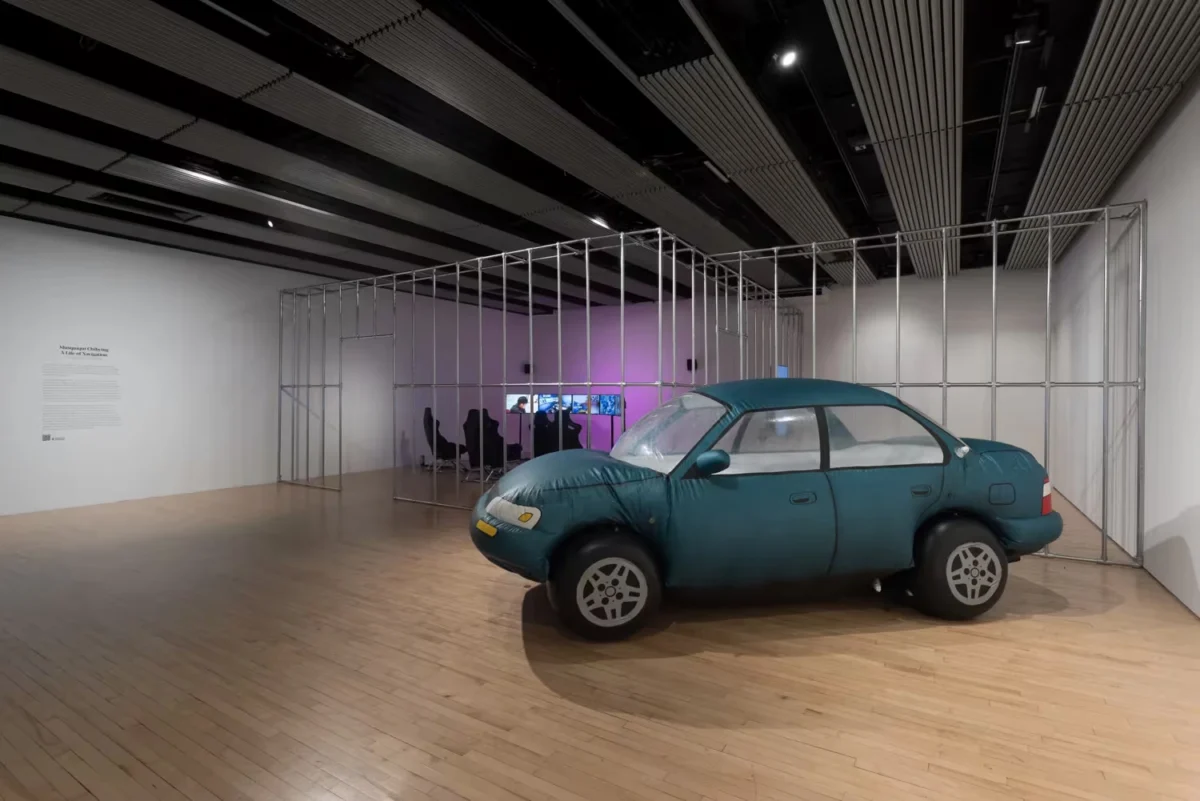
London—What goes through the mind of a German supermarket cashier when a Taiwanese artist uses her checkout counter as a treadmill? Staring upward with a look of profound, resigned bemusement, she watches as he ambles in place, all sharp elbows and knees encased in a pair of diminutive blue shorts.
That runner is artist Musquiqui Chihying, and his futile, humorous exercise session forms the centerpiece of The Jog (2014), the earliest piece featured in “A Life of Navigation.” This concise and intentionally curated mini-retrospective of Chihying’s work has been drawing critical attention at London’s Hayward Gallery, running from August 25 through October 18, 2026. Pulling from a decade of multi-disciplinary practice, the exhibition marries artistic curiosity with sharp humor, charting a compelling evolution in contemporary mood across the past ten years.
The supermarket cashier in The Jog surely grasps the underlying subtext; much of Chihying’s early work playfully needled social realities that were already becoming glaringly apparent to the public by the mid-2010s. In this piece, he takes direct aim at the spiritual alienation embedded within the daily grind, alongside the mundane conveniences that condition modern life, allowing people to keep putting one foot in front of the other regardless of whether that motion is actually getting them anywhere.
The Material Pressures of Modern Urban Life
In a similar thematic vein, the 2015 photographic series The Toyota dwells on the ever-diminishing access to public spaces and dwindling resources that the modern capitalist grind both demands and supposedly provides. Across a row of six framed photographs, the artist captures his father meticulously packing up and dismantling an inflatable plastic car—a whimsical prop used strategically to hold a coveted parking spot in a dense urban environment.
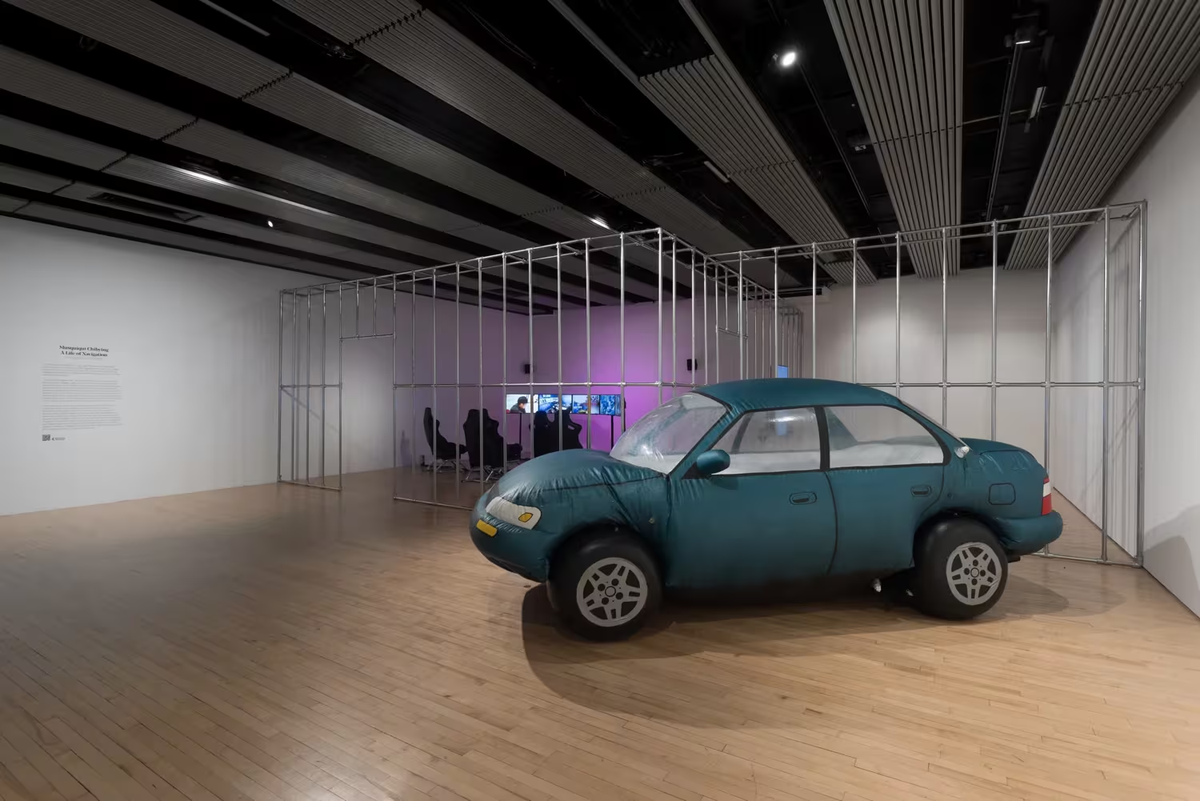
It is a clever ruse, yet one that lays bare the stark realities of the severe squeeze on personal space that is thoroughly rife in high-density metropolises like Taipei. Beyond the immediate logistical struggle for parking, the work nods to a much larger generational shift. Chihying reflects on the Toyota Corolla as a potent symbol of aspirational prosperity that felt remarkably abundant and attainable in the Taipei of his youth. For any young person who has attempted to eke out an independent life in the city in the years since, to be left with nothing more than an inflatable replica parked quietly in the corner of a gallery feels both intensely personal and bitterly relatable.
Viewed from the vantage point of 2026, the social issues addressed in these early works are thoroughly well-trodden, if not slightly nostalgic relics of a different era. Watching Chihying’s light-hearted send-ups of urban bureaucracy and parking scarcity almost triggers a longing for simpler anxieties. It requires little imagination today to picture the artist running in place on a data-collecting, automated self-checkout terminal, while his father remains trapped inside a driverless taxi on its fifth autonomous loop of the city, more anxious about how to disembark than where the vehicle might eventually park.
Yet, that stark contrast is precisely the point. The Hayward Gallery exhibition deliberately highlights the immense gulf of a single decade—underscoring the sheer magnitude of the shift in tactics required to name, understand, and navigate the compounding crises of our contemporary moment.
From Irony to Urgent Inquiry
The trajectory between Chihying’s older and newer works mirrors a classic generational pivot: a distinct movement away from detached irony and toward acute anxiety. The exhibition’s curatorial narrative suggests that the era for gentle poking fun has definitively passed, replaced by an urgent hunger for systemic answers.
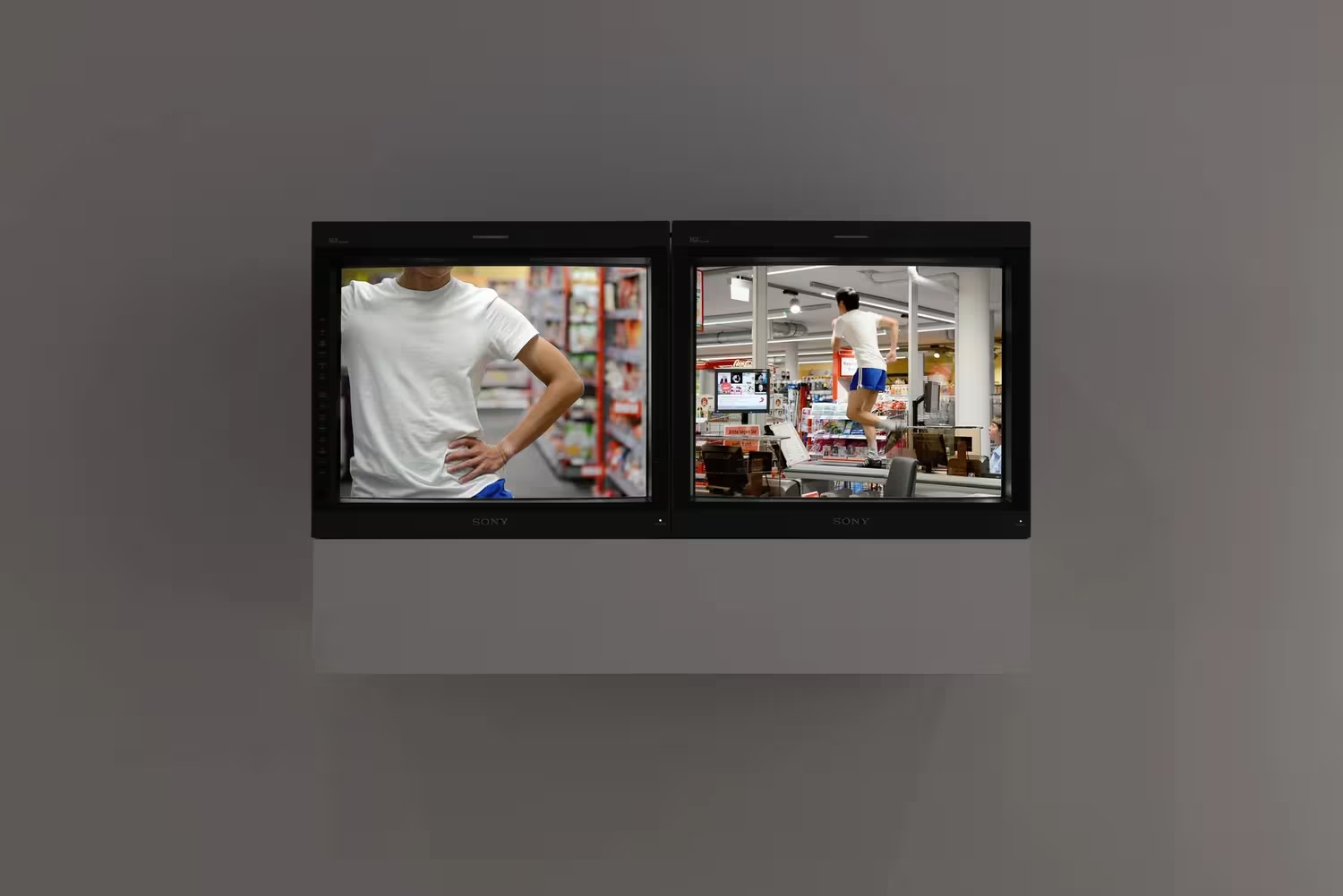
Consequently, Chihying’s more recent works take a deeply inquisitive turn, refining a methodology that has underpinned his practice from the beginning—the interview. His ongoing film project, The Annotation (2025– ), returns once again to the subject of automobiles, but with a modern, unsettling twist: the cars are now fully automated.
Within the gallery space, sleek leather driver’s seats have been wired up for audience members to recline into. As visitors settle, the seats rumble rhythmically, mimicking the sensation of perching atop engines revving of their own accord. The film expands upon earlier explorations of access and systemic alienation by incorporating interviews with artificial intelligence scholars, investigative journalists, and precarious data workers. Together, these voices unpack pressing, high-stakes questions regarding the rapid rise and widespread implementation of autonomous driving technologies. Who truly benefits from these innovations? Whose invisible labor is systematically exploited? And whose human biases, cultural blind spots, and survival instincts are allowed to silently program these technologies as they develop? The talking heads projected on screen grapple with these complex dilemmas without offering easy resolutions.
The ideological stances presented in these newer pieces are notably less clear-cut than the straightforward social commentaries of Chihying’s earlier career. At one juncture in the film, a Taipei taxi driver expresses genuine enthusiasm for the prospect of lavender-scented, automated cabs that would free her from the daily stress of dealing with unpredictable or potentially dangerous human passengers—even while implicitly recognizing that the widespread adoption of such technology will likely render her own profession obsolete. In parallel conversations across the installation, industry experts acknowledge the vital contributions of women to the burgeoning tech sector, while simultaneously calling out the exploitative labor practices inflicted upon underpaid data annotators located across the African continent.
Afro-Asian Entanglements and Digital Labor
Chihying zeroes in on this latter dynamic of global digital labor within another major short film featured in the exhibition, carving out substantial space for one of the defining threads of his recent research: the complex Afro-Asian entanglements produced by emerging technological fields like AI and the gaming industry.
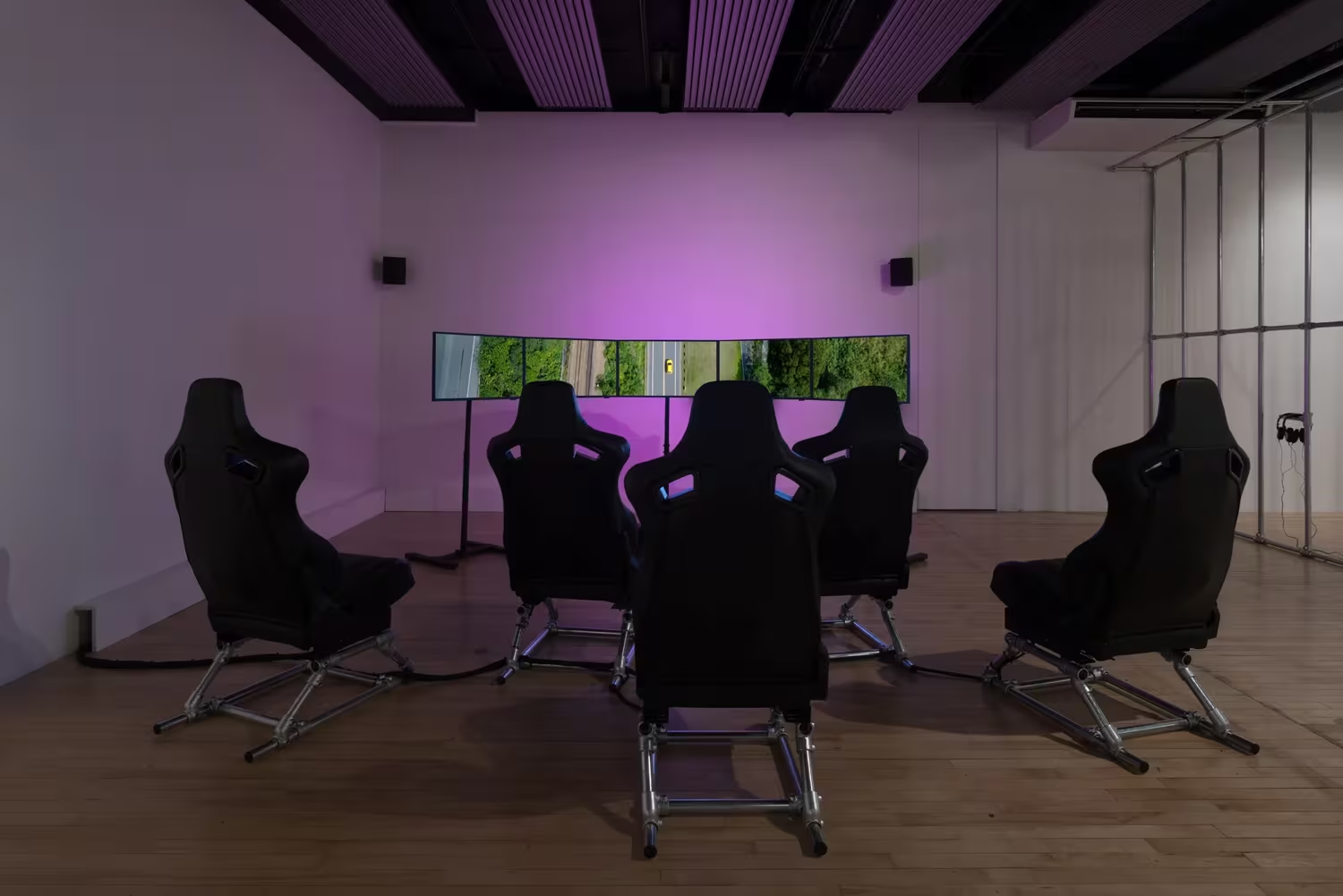
The Gamer (2026) follows a cohort of young people living in Nigeria who carve out a precarious livelihood by playing video games like Call of Duty. They spend their days hunting for high competitive ranks and rare virtual items on behalf of paying clients located predominantly in China and Japan. This digital gig work echoes the core revelations of The Annotation, highlighting how highly educated yet economically marginalized workers in former British colonies are routinely roped into tagging data and performing digital labor to maximize the profits of technology developers headquartered thousands of miles away.
Between delivering direct, thoughtful answers to Chihying’s camera, the interviewees in The Gamer move through abandoned or unfinished buildings wielding sawed-off drainpipes and splintered wooden planks, essentially live-action role-playing the first-person shooter games that pay their bills. It is a striking echo of the irreverent choreography that Chihying once deployed atop a German supermarket conveyor belt to lambast the absurdity and alienation of modern consumer culture. However, in this newer context, the rigorous depth with which these recent works delve into the unsung quirks, human stories, and structural nuances of nascent global industries allows the artist to project a profound sense of unease onto an entirely new generation.
Christopher Whitfield is a writer and educator based in Taipei.