Beyond the Ring Road: Navigating the Raw Wilderness and Rising Realities of Iceland’s Volcanic Highlands
Accessible only to those prepared for unpredictable elements, Iceland’s highland routes promise adventure beyond the reach of most. Weathered gravel paths cross vast, raw landscapes seldom altered by human presence. Making the journey here reshapes what it means to explore wild places responsibly and safely, shifting the focus from passive sightseeing to active, mindful engagement with one of the most volatile environments on the European continent.
The stark differences between Iceland’s interior highlands and its more-traveled coastal routes are immediately apparent upon arrival. While the famous ring roads skirt the island’s periphery, providing relatively smooth passage through settled coastal towns, farming valleys, and developed tourist hubs, highland roads slice directly through its volcanic heart. This interior crossing offers a profound sense of isolation rarely experienced elsewhere in the modern world. For many explorers, driving Iceland’s F-roads transforms an ordinary road trip into a genuine wilderness experience, opening up vast possibilities for backcountry discovery that remain entirely hidden from the vantage point of paved national highways.
The practical difference centers fundamentally on remoteness, limited infrastructure, and the uniquely rugged terrain that demands both deep preparation and profound respect from every traveler venturing off the main circuit. Where the coast offers convenience, fuel stations, and rapid emergency response times, the highlands require a psychological and mechanical shift toward self-reliance. Here, the landscape dictates the terms of travel, reminding visitors that Iceland’s interior remains a dynamic, untamed domain shaped by geological forces that are perpetually active beneath the surface.
Unpredictable terrain and constant environmental changes
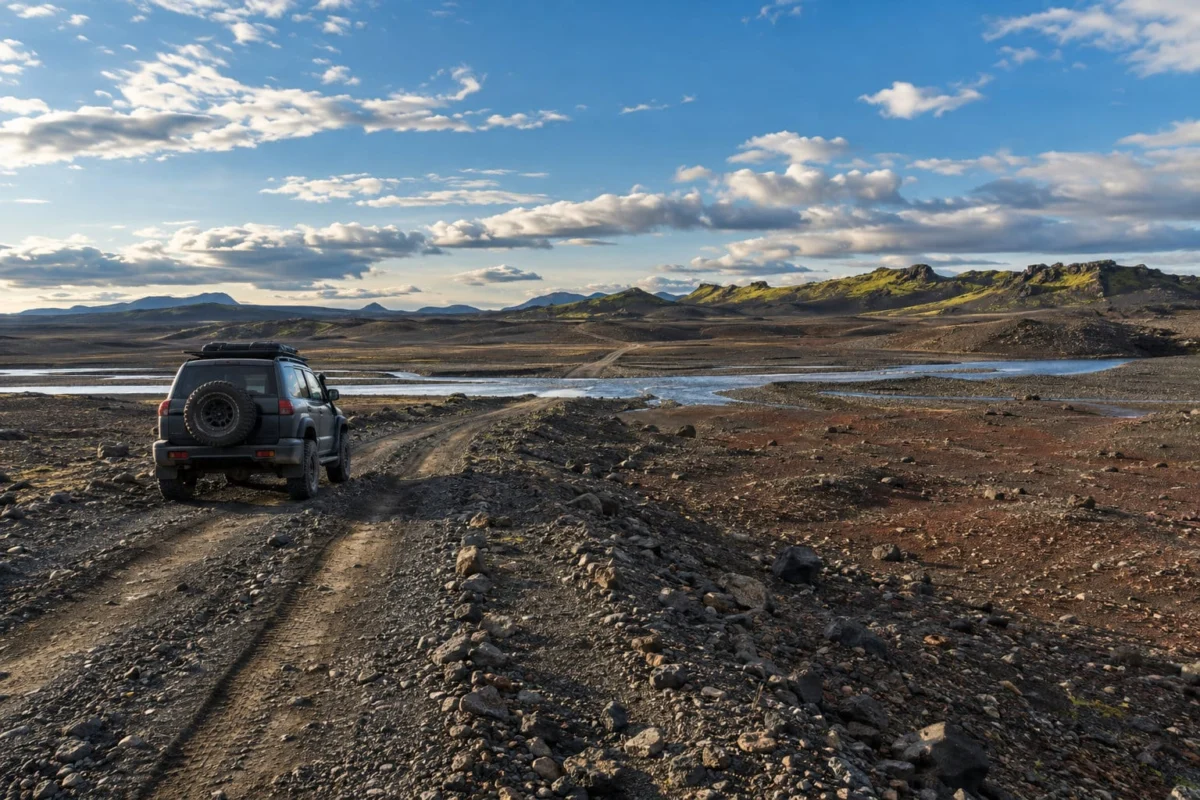
Unlike the paved highways along the coast, highland roads are often rutted gravel tracks that cross expansive lava fields, windswept black sand deserts, and braided glacial rivers. These routes frequently challenge drivers with demanding obstacles such as unbridged river crossings, whose depth, temperature, and current can shift dramatically and quickly with sudden rainfall, geothermal activity, or daytime snowmelt. A crossing that appears manageable in the crisp morning hours can transform into a hazardous torrent by the afternoon, requiring drivers to constantly evaluate environmental cues before committing their vehicles to the water.
Travel speeds across the interior are necessarily much slower than those on standard highways, as loose volcanic gravel and frequent washboard surfaces drastically reduce tire traction and demand exceptionally careful navigation. Potholes, sharp volcanic rocks, blind rises, and uneven road sections keep motorists perpetually alert. This demanding environment emphasizes the absolute necessity for high-clearance four-wheel-drive vehicles and an adaptive mindset, especially as weather conditions may shift with little to no warning, turning a clear day into a blinding whiteout or a torrential downpour in a matter of minutes.
The physical makeup of the terrain itself is a testament to Iceland’s fiery origins. Driving through these corridors means traversing expanses of dark basalt, ancient calderas, and ash deposits that have been shaped by millennia of wind, ice, and fire. The sheer scale of the horizon can be disorienting, and the lack of familiar landmarks or vegetative markers means that navigation relies heavily on precise route-planning, road markers, and an acute awareness of one’s surroundings. Every mile traveled in the highlands is a negotiation with a landscape that refuses to conform to human engineering standards.
Planning, safety, and remote self-sufficiency matters
Before setting out into the interior, mapping a realistic route and building in conservative timelines are essential measures to avoid the dangerous pressure of time constraints under unpredictable conditions. Because weather and road status can change instantly, predetermined turnaround points should always be integrated into every travel plan. Recognizing when to turn back because weather systems are closing in or rivers have become impassable is a critical skill; flexibility and caution form the absolute backbone of safe travel in these remote latitudes.
Communication gaps are the standard rather than the exception on these interior routes, as cellular coverage is frequently non-existent amid the deep valleys and high plateaus. Support services and emergency roadside assistance are exceptionally rare or entirely non-existent for miles in any direction. Consequently, it is wise for travelers to prepare thoroughly for recovery situations without ever counting on outside assistance to bail them out of trouble. Carrying essential recovery tools, extra provisions, emergency warm clothing, and keeping trusted contacts informed of a detailed, day-by-day itinerary can help mitigate severe risk and allow a crucial measure of self-sufficiency when operating far from civilization.
This reliance on self-sufficiency extends to vehicle management and mechanical preparedness. A flat tire, a cracked oil pan, or a stalled engine in the highlands carries a completely different weight than it does along a populated coastal route. Travelers must understand the capabilities and limitations of their transport, ensuring they are equipped to handle minor mechanical setbacks independently while waiting out adverse weather if necessary. The freedom of the open interior is thus counterbalanced by the heavy responsibility of personal accountability.
Environmental stewardship while exploring remote landscapes
Staying strictly on marked tracks is paramount to protecting fragile volcanic soils and delicate Arctic mosses from irreversible damage, making off-road driving not only environmentally harmful but strictly prohibited under Icelandic law. Minimizing wildlife disturbance and respecting seasonal road closures—which are put in place by authorities precisely when the ground is too wet and vulnerable to bear vehicle weight—are key components of responsible travel. These measures ensure that the delicate balance of the ecosystem is preserved and that the highlands remain accessible for future generations of explorers.
Leave No Trace principles take on an amplified, visceral importance in the wide-open, fragile terrain of Iceland’s highlands, where a single piece of litter or a careless tread can remain visible and damaging for decades. Practically, this means planning meticulously to pack out all rubbish, avoiding the construction of new fire rings or rock cairns that scar the natural landscape, and treading lightly even during short roadside stops. The scars left by human carelessness heal at an extraordinarily slow pace in the harsh Arctic climate, making the restraint and mindfulness of every visitor vital to the conservation of the region.
As interest in Iceland’s interior continues to grow among adventure-seeking travelers, the balance between public access and environmental preservation remains delicate. The call of the highlands is powerful, drawing those who wish to witness the raw, elemental beauty of the earth untouched by urbanization. Yet, answering that call responsibly requires an acknowledgment that these landscapes are not merely playgrounds, but living, dynamic environments that demand respect, preparation, and an enduring commitment to stewardship.