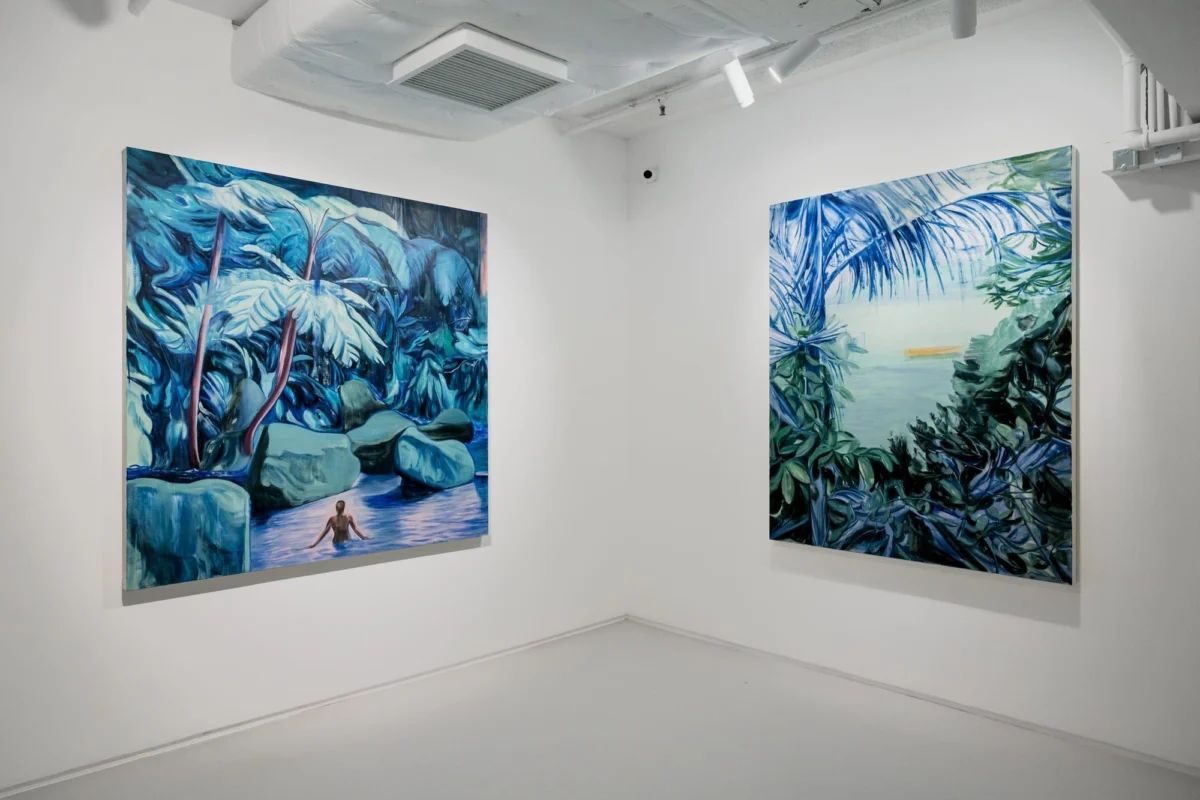
Hong Kong — How is the tempo of time marked? What pace do the hours keep to when they are not measured by the rigid ticking of a clock? These philosophical questions have long fascinated Shanghai-based contemporary artist Qi Lei, and they receive a sustained, deeply poetic inquiry in his solo exhibition, "Echoes of Day and Night," hosted at Ben Brown Fine Arts in Hong Kong. Running from September 12 through October 31, 2026, the exhibition brings together a compelling body of oil paintings that explore the intersection of memory, pictorial rhythm, and temporal fluidity.
Drawing inspiration from traditional Western landscape conventions as well as the sweeping, atmospheric post-rock instrumentals of bands such as Godspeed You! Black Emperor, Qi examines how pictorial rhythm can be orchestrated entirely through oil paint. In his hands, the painter assumes the role of a composer, orchestrating color, mass, and brushstroke to conduct the illusion of duration on a static canvas.
The exhibition invites viewers into a realm where the boundaries between daybreak and twilight dissolve, offering an immersive experience that challenges conventional perceptions of space and narrative.
Composing Silence: Blue Sonata and Early Light
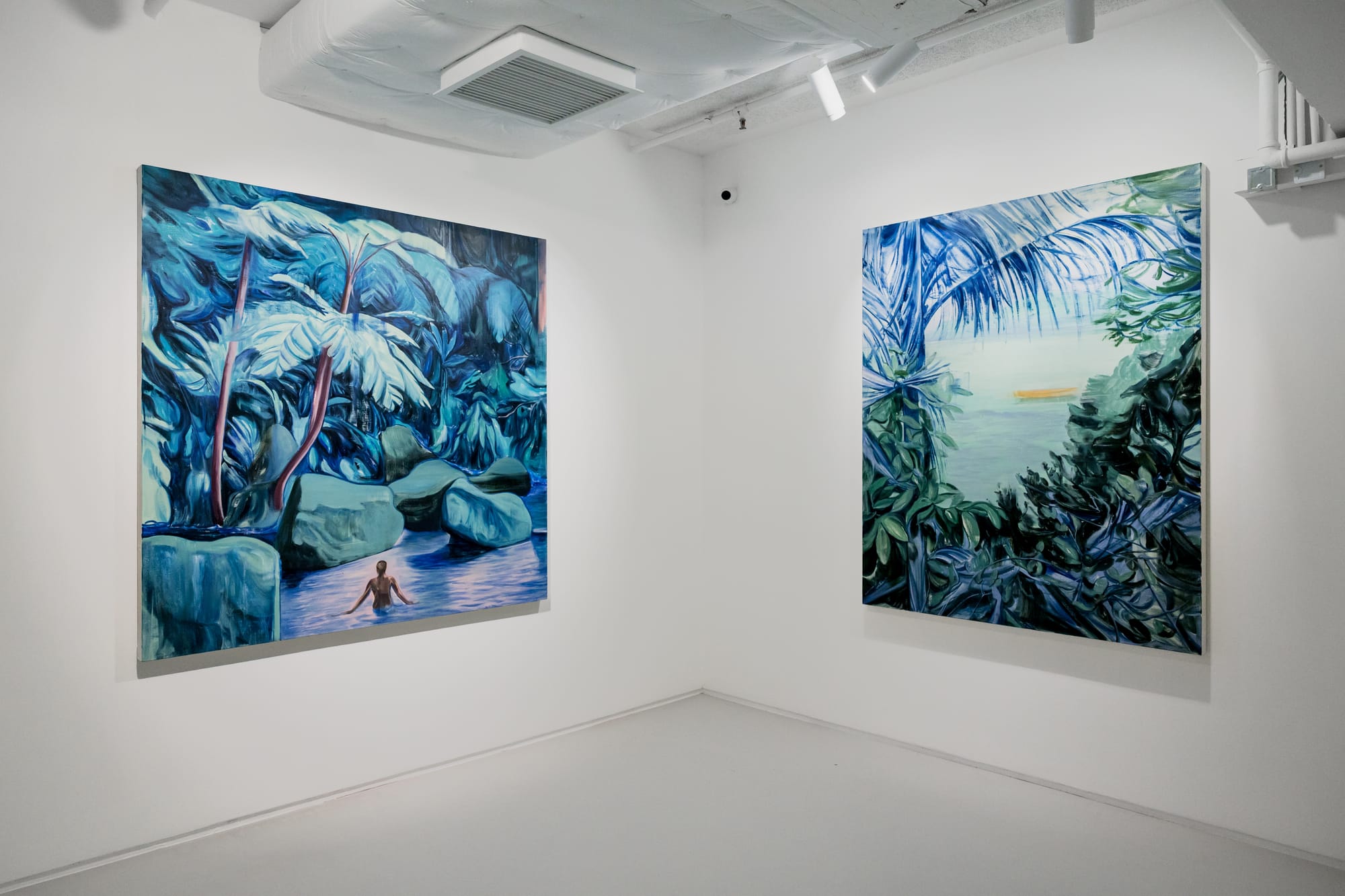
The musical underpinnings of Qi’s artistic practice are immediately apparent in works like Blue Sonata (2020). In this canvas, a solitary canoe drifts through a misty jungle clearing, cutting across a hazy, undisturbed expanse of water. Qi’s deliberate framing evokes the compositional vignette of classic Romantic seascapes, such as Caspar David Friedrich’s seminal Chalk Cliffs on Rügen (c. 1818). However, where Friedrich’s historical work populates the landscape with observant human figures, Qi strips the scene down to its bare essentials, leaving only an empty, drifting vessel to anchor the viewer’s gaze.
A palette dominated by cool blues and greens calls to mind Frank Sinatra’s evocative 1955 concept album In the Wee Small Hours, which itself serves as a profound exploration of the lonesome cadence of a nascent morning. As viewers look closer, elements of abstraction begin to materialize in the surrounding environment. Lush vegetation blurs into unknown, intricate, and almost insectile shapes, forming a stark visual contrast with the spare, precise brushstrokes used to define the distant hull of the canoe. An illusory musicality permeates the entire tableau, moving steadily and quietly through the calm waters. Through this careful orchestration, Qi characterizes first light not as a sudden awakening, but as an unhurried, elusive dream unfolding slowly across the canvas.
Chromatic Tones and Abrupt Stillness in Hunting
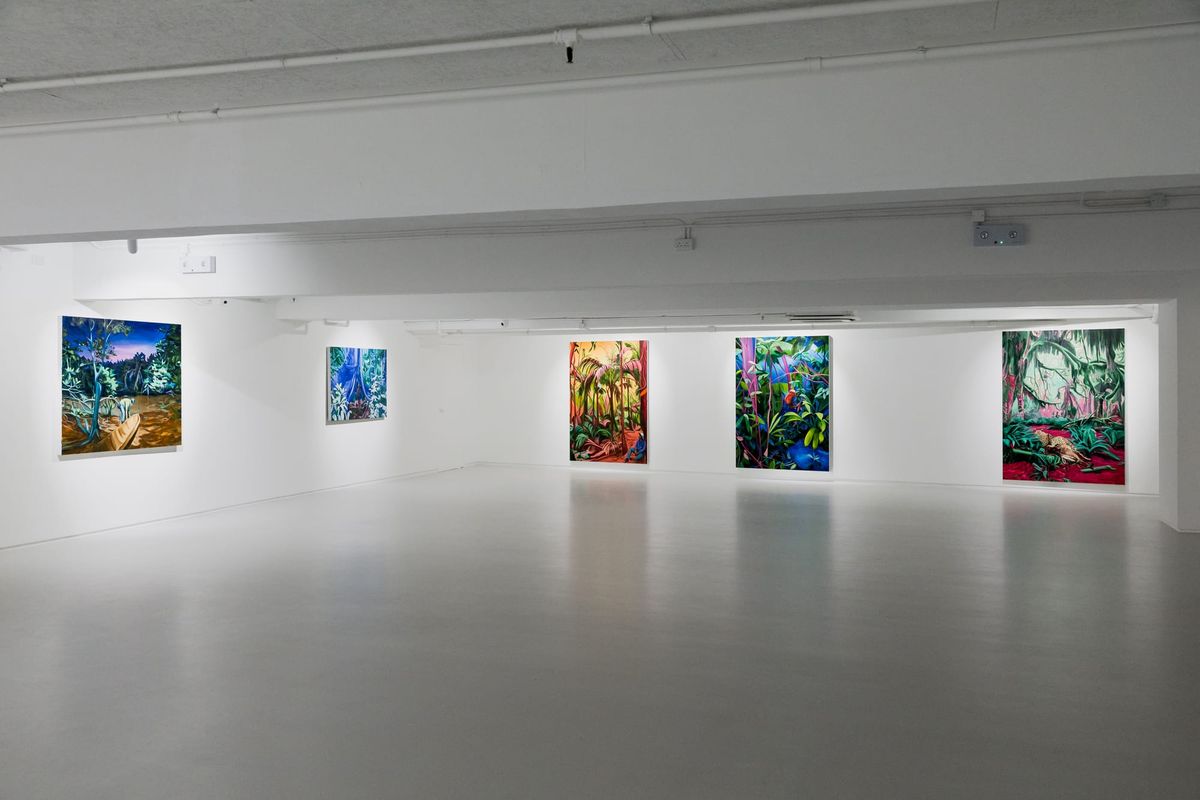
The exhibition demonstrates Qi’s versatility by shifting tones and palettes in works such as Hunting (2021). Here, the contemplative tranquility of Blue Sonata gives way to opposite chromatic tones. A leopard sits triumphantly atop its kill within the confines of a dense jungle, bathed in the rosy, fading fingers of dusk.
While the narrative subject matter immediately recalls the theatrical jungle scenes of Henri Rousseau, most notably Le lion, ayant faim, se jette sur l’antilope (1898–1905), Qi actively resists Rousseau’s dramatic staging and crisp figurative clarity. Rather than occupying pride of place as the undeniable focal point of the painting, the beasts in Qi’s work tend to merge directly into the surrounding thicket.
Sponged smears of oil blur the foliage and the foreground together into chimerical distortions. This subtractive handling of the medium is deliberately designed to deconstruct traditional figurative clarity, forcing the viewer to look past the initial subject to appreciate the texture and atmosphere. Channeling his deep fascination with complex musical structures, Qi charges the canvas with an abrupt stillness. The effect is akin to the pregnant, heavy pause that follows a high-intensity musical crescendo—as if the chase of the hunt has only just ended, leaving behind a profound, reverberating silence.
Thresholds of Time and the Human Form
The motif of the lone canoe reappears with striking new resonance in Morning mist rises at dusk (2026). In this later work, the empty vessel is now accompanied by a human figure whose torso seamlessly blends into the surrounding branches, while their face is left deliberately blank and unresolved. Like the leopard in Hunting, this human form is subordinated to the wider composition rather than commanding it; shape, contour, and color act less as portraits of individuals and more as instruments within a larger visual ensemble.
Temporal anonymity reaches its absolute zenith in this piece. An indigo sky is fractured by a delicate pink haze, leaving the exact hour lost somewhere indeterminably between daybreak and twilight. Even the figure’s physical gesture remains profoundly ambiguous: are they launching the craft into the water, or are they dragging it ashore? Caught perpetually between thresholds, a transitory tension holds pictorial rhythm at a complete standstill. What remains for the viewer is an insoluble suspense, an open-ended narrative moment frozen in paint.
Wading Through a Painted Dream
Walking through Qi Lei’s solo exhibition at Ben Brown Fine Arts can feel remarkably like wading through a lingering dream. In this altered reality, colors are unnaturally vibrant, recognizable natural forms buckle under the weight of atmospheric distortion, and the underlying pulse of time is experienced as simultaneously fluid and rigid.
Throughout the galleries, the artist’s meticulous brushwork operates much like a steady metronome, while spatial massing and compositional weight provide the percussive beats. The shifting hues of sunrise and sunset answer to one another across the walls, establishing a continuous dialogue between the works. Ultimately, Qi’s exhibition poses a poetic and lingering question to every visitor who steps inside: After all, what is dusk, if not simply an echo of the dawn?
Harison Butler is an editorial intern at ArtAsiaPacific.