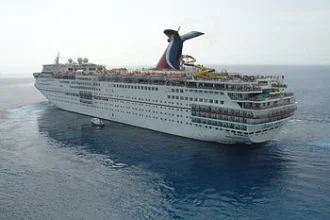
The public relations trajectory of the modern cruise industry has weathered its share of turbulence over the last few years, but recent events suggest a fundamental shift in how consumers and the market perceive major onboard mishaps. When the Carnival Splendor suffered an engine room fire in November 2010—promptly dubbed the "Pop Tart Cruise" by industry observers—the incident was greeted largely with public curiosity. It created virtually no lasting impact on overall cruise bookings or ticket pricing, proving that minor anomalies rarely disrupt a rapidly expanding sector.
That resilient baseline was tested sharply in January 2012 with the tragic Costa Concordia disaster, an event that was met with widespread public shock. Bookings and ticket prices dropped immediately. While those metrics have since recovered over time, the public consciousness of the event has proven remarkably durable, keeping figures like Captain Francesco Schettino embedded in the cultural lexicon.
Now, the industry faces yet another severe test following the "Cruise from Hell" aboard the Carnival Triumph in February 2013. Rather than inspiring curiosity or mere shock, this latest high-profile maritime failure is increasingly being greeted by the traveling public with a collective sense that enough is enough.
To be fair, operating thousands of voyages annually means that minor operational hurdles are an inevitable part of maritime logistics. With more than 10,000 annual cruise sailings taking place around the globe, minor incidents such as pier bumps or encounters with rogue waves happen periodically. Furthermore, with the industry boasting a robust seven percent compounded annual growth rate, the statistical likelihood of facing adverse events naturally multiplies.
Nevertheless, corporate strategy during crisis management can sometimes defy expectations. When a major cruise operator dusts off a pre-Concordia advertising campaign themed around "Land vs. Sea: So Many Choices" to run during the subsequent year’s critical wave season, outside observers are rightly tempted to question the underlying corporate judgment.
Corporate memories in the travel sector are notoriously short, and the mainstream media inevitably moves on to new headlines. Carnival Corporation is no stranger to early operational hurdles; the company famously overcame the embarrassment of its very first cruise ship, the Mardi Gras, running aground on a sandbar during its inaugural voyage in 1972. Industry analysts also caution against expecting any immediate, dramatic drops in ticket prices across the board. Following the Costa Concordia disaster, prices for close-in sailings—those sold one to three months in advance of departure—took a full five months to bottom out in June 2012.
The immediate financial impact to the bottom line can be quantified by simply accounting for the canceled voyages resulting from the incident. According to data from Cruise Pulse, the direct toll encompasses the 14 canceled Triumph sailings originally scheduled between February 11th and April 13th, 2013, alongside the ill-fated February 7th voyage. Together, these cancellations total approximately $20.8 million in lost ticket revenue.
However, official corporate guidance may be underestimating the true scope of the operational downtime. By comparison, when the Carnival Splendor was forced out of service, it remained offline for a total of 101 days. Against that historical benchmark, current Triumph guidance projecting an offline period of 71 days appears overly aggressive. Industry projections indicate that the Carnival Triumph will likely be forced to cancel an additional seven cruises stretching up to the May 5th sailing, which would add another $9.8 million to the tally of lost ticket revenue.
Unfortunately, the financial story does not end with canceled sailings alone. On the operational margins, where incoming cash from ticket revenues intersects directly with fixed corporate expenses, the financial strain of the event will continue to be felt by the operator. This comes at a particularly delicate time for the wider cruise sector, which is already navigating a complex macroeconomic landscape. Companies are actively being squeezed by a slowing European economy, alongside persistent inflationary pressures affecting the costs of marine fuel and victualing.
The deeper psychological challenge for the industry lies in shifting consumer sentiment. When prospective cruisers hear stranded Triumph passengers expressing sentiments such as, "The credit, refund, and $500 aren’t really important. It’s not about the money. We will pay Carnival anything just to let us off the ship," industry executives have to wonder whether this time will genuinely be different.
For repeat customers and die-hard cruise enthusiasts, high-profile incidents usually translate into deeper bargains and discounted fares. History demonstrates that when ticket prices drop low enough, consumer memories tend to fade remarkably fast. Yet, no amount of corporate public relations spin can successfully turn this level of negative publicity into a positive development for the broader cruise market.
Sustaining long-term sector growth requires maintaining consumer confidence on multiple fronts. In order to attract top-tier maritime talent to work aboard modern ships, continue penetrating the massive untapped market of consumers who have "never before cruised," and maintain the confidence of investors drawn to exponential passenger growth, these types of catastrophic operational failures simply cannot continue to happen with regularity.
With roughly 10,000 more voyages scheduled across the industry over the coming year, getting the execution right 99.99% of the time is critical. Ensuring that millions of cruisers leave their vacations satisfied and eager to share positive personal experiences remains the bedrock of the business model. In the interim, firms like Cruise Market Watch will continue closely monitoring ticket revenue streams and broader pricing trends to evaluate the true lingering cost of the crisis.