Manchester—As visitors enter the galleries of the Whitworth for the Hyundai Translocal Series: Entangled and Woven, they are greeted by an expansive exploration of textile traditions that bridges geographies, histories, and spiritual philosophies. Running from July 10, 2026, through January 3, 2027, the exhibition showcases new textile-based commissions developed through a series of intensive research exchanges by four South Korean artists and four Indian artists.
Set against a contemporary socio-political backdrop characterized by rising xenophobic tides and increasingly rigid national borders, the exhibition offers a powerful counter-narrative. By immersing themselves in one another’s craft traditions, the participating artists have produced a presentation that is as dazzling in its technical virtuosity as it is profound in its excavation of past and present cultural connections.
The conceptual foundation of the exhibition is deeply rooted in ancient epics, spiritual paradigms, and multifaceted notions of truth. One of the central touchstones of the exhibition is the parable of the Navangunjara, a divine chimera that confronts the warrior Arjuna in the 15th-century Odia retelling of the Mahabharata by poet Sarala Dasa. In the epic tale, Arjuna has just settled into prayer when he is startled by the sight of a fantastical beast composed of nine distinct animal parts. Reaching instinctively for his bow and arrow, Arjuna pauses when he notices a lotus flower—the unmistakable emblem of Lord Krishna—held within the creature’s human hand.
This mythological encounter serves as a profound metaphor for the exhibition as a whole: truth is multifaceted, sometimes difficult to behold in its entirety, yet subtly inflected in everything and everyone. The works featured in Entangled and Woven translate this philosophy into physical form, utilizing fabric, thread, natural dyes, and architectural motifs to explore how cultures across Asia are inextricably linked.
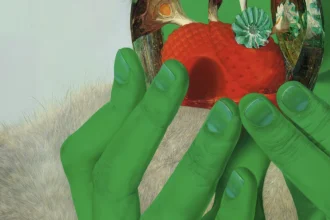
The state of Odisha, where the legend of the Navangunjara originates, is directly represented in the exhibition by the art-and-fashion collective Boito. True to the mythological description, Boito has crafted a striking sculpture of the Navangunjara where each anatomical component is rendered through a distinct local craft tradition. For instance, the creature’s proud peacock neck is meticulously covered in cloth-based pattachitra paintings, while its sinuous serpent tail is formed from intricately plaited sabai grass.
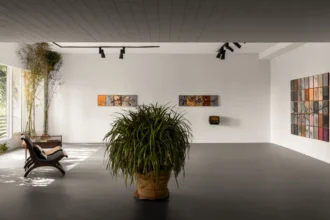
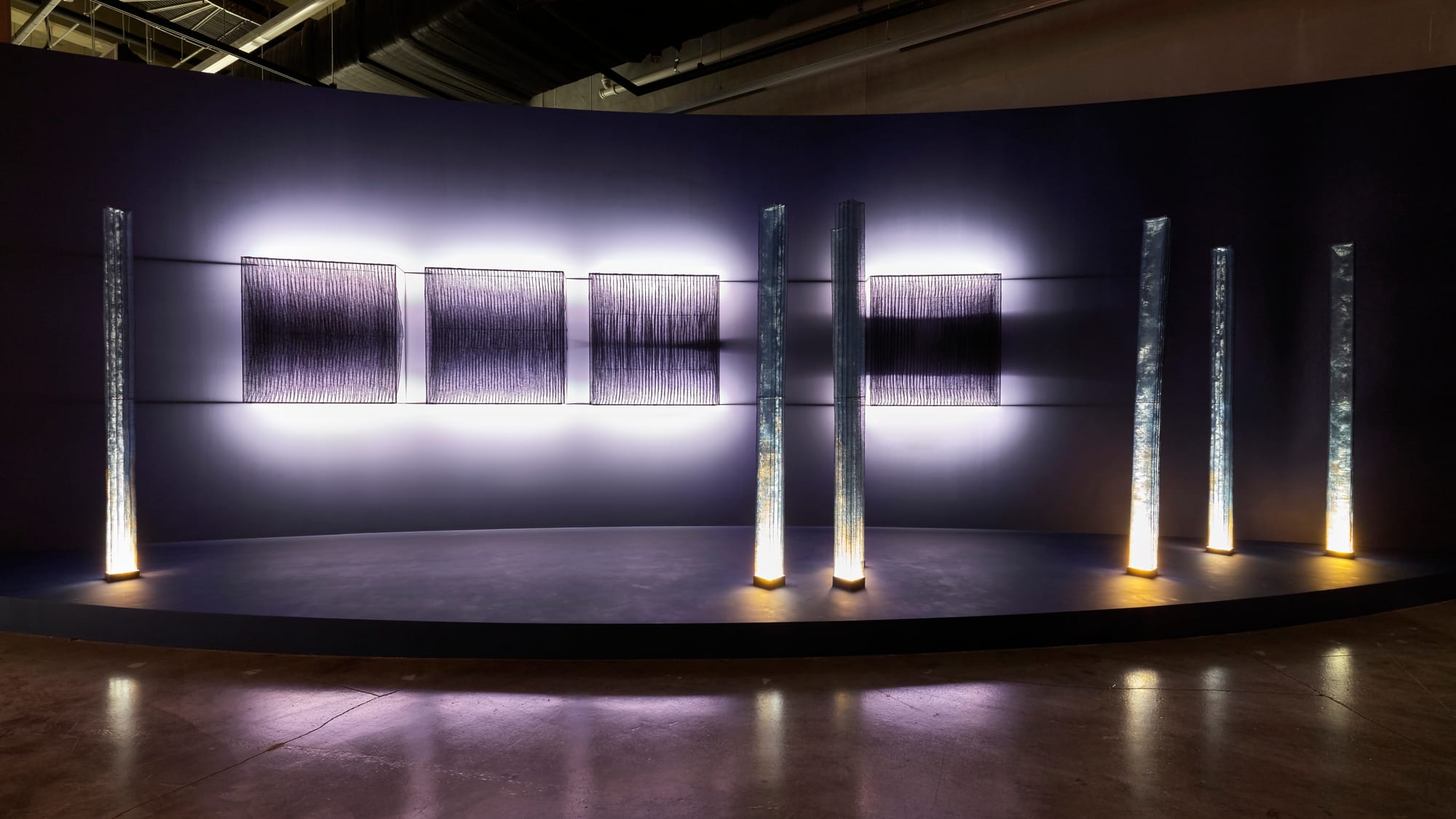
Spiritual and philosophical motifs drawn from 15th-century literature continue to resonate in the work of South Korean artist Yeonsoon Chang. The title of Chang’s Worincheongang series (2025) translates directly to "the moon reflected on a thousand rivers," a deeply resonant Buddhist teaching that echoes the notion that absolute truth is never singular, but rather manifests in a multitude of diverse forms. For this installation, Chang has carefully sewn and ironed indigo-dyed abacá fabric into nearly prismatic structures. These forms create subtle, shifting gradients of light that vividly evoke the ethereal quality of moonlight cast upon moving water.
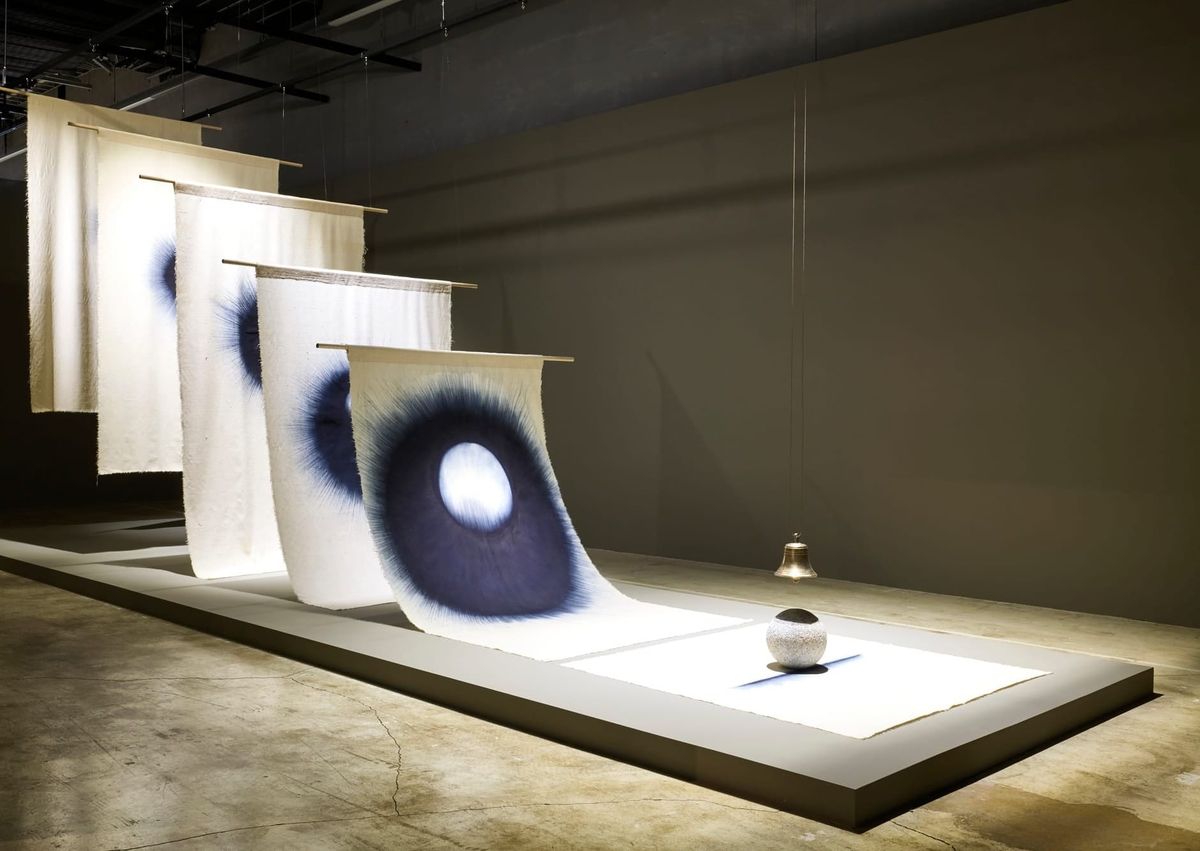
Indigo, a medium rich with both spiritual and painful historical resonance, also forms the core of Kaimurai’s installation. Viewing the deep blue pigment as sacred, Kaimurai paints dense, radial lines in a deeply meditative process. In a thoughtful curatorial dialogue, Kaimurai’s contemporary piece is placed in proximity to a 19th-century indigo resist-dyed cotton fragment drawn directly from the Whitworth’s historic collection in Manchester.
This historical inclusion subtly complicates the exhibition’s material histories by nodding to the intense European demand for "blue gold" during the colonial era. Because of its immense popularity and profitability in Western markets, indigo was widely cultivated across India, frequently displacing essential food crops and devastating local agrarian economies. The resulting hardships eventually culminated in the Indigo Revolt of 1859, when farmers rose up against colonial planters. By incorporating the 19th-century textile artifact from Manchester’s own museum holdings, the exhibition successfully bridges contemporary artistic practice with the darker, complex threads of imperial history.
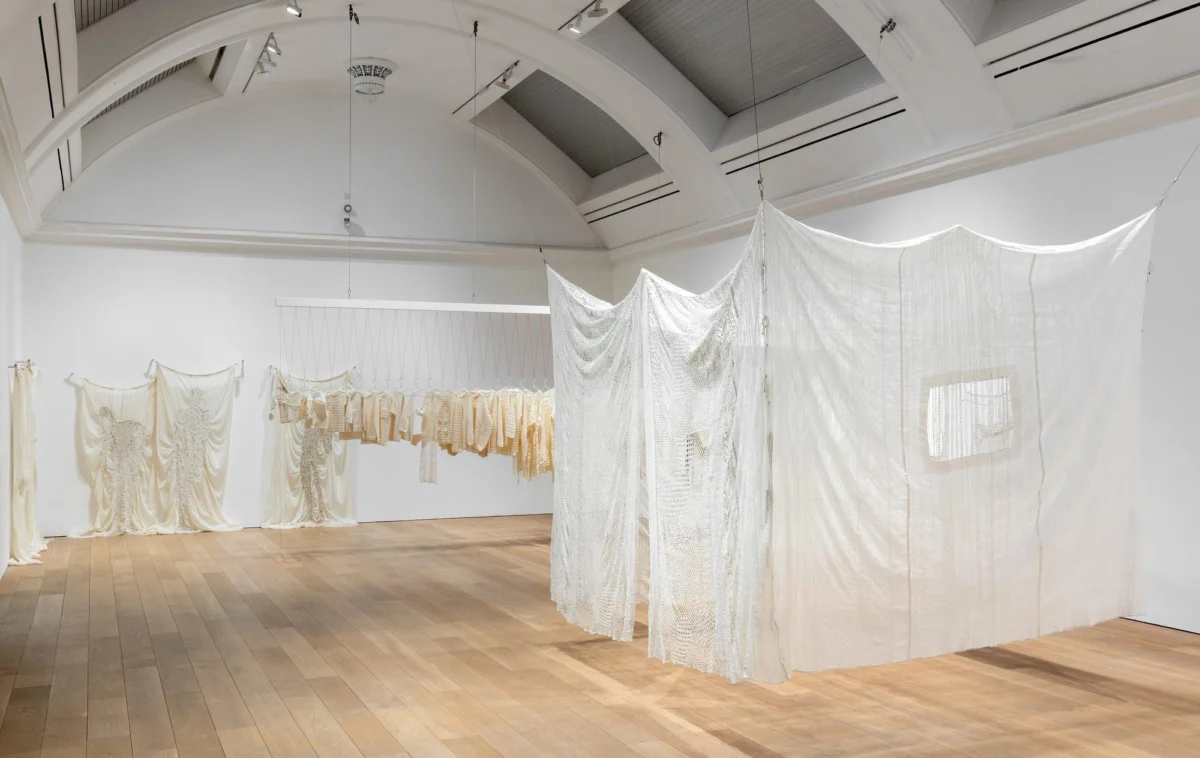
The theme of architectural and spiritual symmetries is further expanded in Sumakshi Singh’s Spanning the Void (2025). Singh’s work meticulously recreates a historic footbridge located in Cheongju using delicate lace. The intricately worked gossamer threads faithfully replicate the bridge’s original wooden texture as well as the swastika symbol embedded within its fencing—an ancient motif that speaks to the historical spread of Buddhism from India to East Asia along the ancient Silk Road.
Another striking engagement with religious architecture can be found in Jounghye Yoo’s installation. Yoo utilizes diaphanous layers of fabric bearing gold embroidered patterns alongside Ajrakh hand-block printed and resistance-dyed motifs. These translucent textile layers are purposefully cut and arranged to resemble the monumental gate of the Vishwanath Temple in Varanasi.
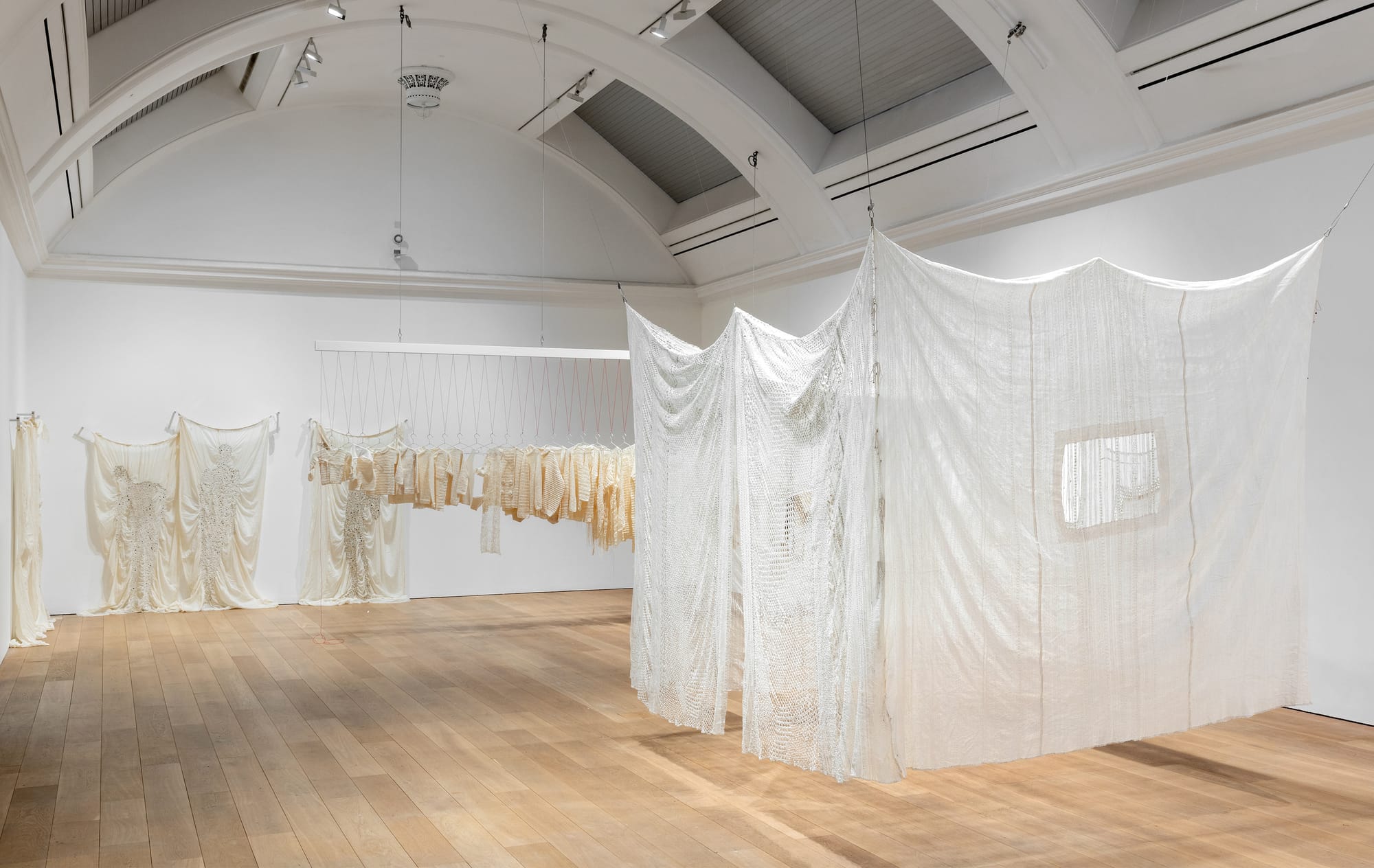
Similarly drawing on architectural forms and the human body, the fashion label Pérez uses the structural language of textiles to evoke historical spaces. Their installation, Entangled Memories, Interwoven Stories (2015–2025), is constructed entirely from the specialized stitching normally hidden away to close seams and raw edges in garments. The intricate web of threadwork powerfully recalls the ornate marble lattice screens found in Mughal palaces.
Furthermore, this elaborate stitching mirrors the aesthetic of an ornate, patterned Chikankari mat from the Whitworth’s permanent collection. Like the indigo fragment, this artifact sheds light on the trajectory of colonial histories. Developed originally during the prosperous Mughal era, white-on-white Chikankari embroidery suffered a severe decline under British rule as it was steadily outcompeted by industrially manufactured textiles pouring out of British mills. The craft managed to survive solely as a domestic art form, quietly passed down between generations of women who utilized the skill to earn a meager living.
The vital contributions of working-class women to the history of textile craft are brought into sharp focus in Young In Hong’s Sacred Empires (2025). This striking series of flags was created in collaboration with the Kala Raksha collective in Kutch, India, where diverse styles of mirrorwork and embroidery are celebrated as distinctive visual markers of specific communities and lineages. Adorned with dainty circular mirrors and vibrant, meticulous stitching, the patchwork banners represent animal colonies and their fluid, shifting territories, thereby positing human and cultural identity as both intrinsic and continually responsive to the environment.
The shimmering presence of mirrorwork embroidery reappears in Somi Ko’s People of One, Moment (2025). In Ko’s installation, glimmering circular mirrors are meticulously arranged across five distinct panels of cotton, forming the silhouettes of figures caught in the ecstasy of dance. These radiant moments of movement and reflection convey a fundamental truth that underpins the entire philosophical framework of Entangled and Woven: humanity contains reflections of one another, and through this profound interconnection, we serve as each other’s greatest teachers.
Hyundai Translocal Series: Entangled and Woven remains on view at the Whitworth in Manchester through January 3, 2027, offering audiences a rare opportunity to witness how contemporary artists are actively repairing, re-examining, and re-threading the complex historical connections between South Korea and India.