Sydney — At Tallawoladah, the traditional lands of the Gadigal people, the Museum of Contemporary Art Australia (MCA) occupies a unique and heavily contested physical and cultural geography. Positioned gracefully between the bustling tourist precincts of Circular Quay and The Rocks—and standing remarkably close to the foundational site of British colonization in Australia—the museum serves as a bridge between two distinct economies of national culture: the solemn, authorized institutional archive and the transient, commercial souvenir trade.
It was within this deeply charged and symbolic setting that the museum hosted “Tony Albert: Not a Souvenir,” the largest exhibition to date for the acclaimed Girramay, Yidinji, and Kuku Yalanji artist. Bringing together more than 150 diverse works spanning multiple mediums, the landmark exhibition offered a profound examination of how Indigenous Australian culture has historically been simplified, commodified, and mass-circulated for non-Indigenous consumption. More importantly, the show charted an uncompromising path toward how these pervasive, often harmful representations might be reclaimed, recontextualized, and thoroughly subverted.
“Clarity,” emphasized Wierdi curator Bruce Johnson McLean during the development of the retrospective, served as the primary guiding force behind the project. Yet, achieving true clarity is inherently complicated when confronting visual material that is at once deeply familiar to generations of Australians and fundamentally insidious in its cultural impact.

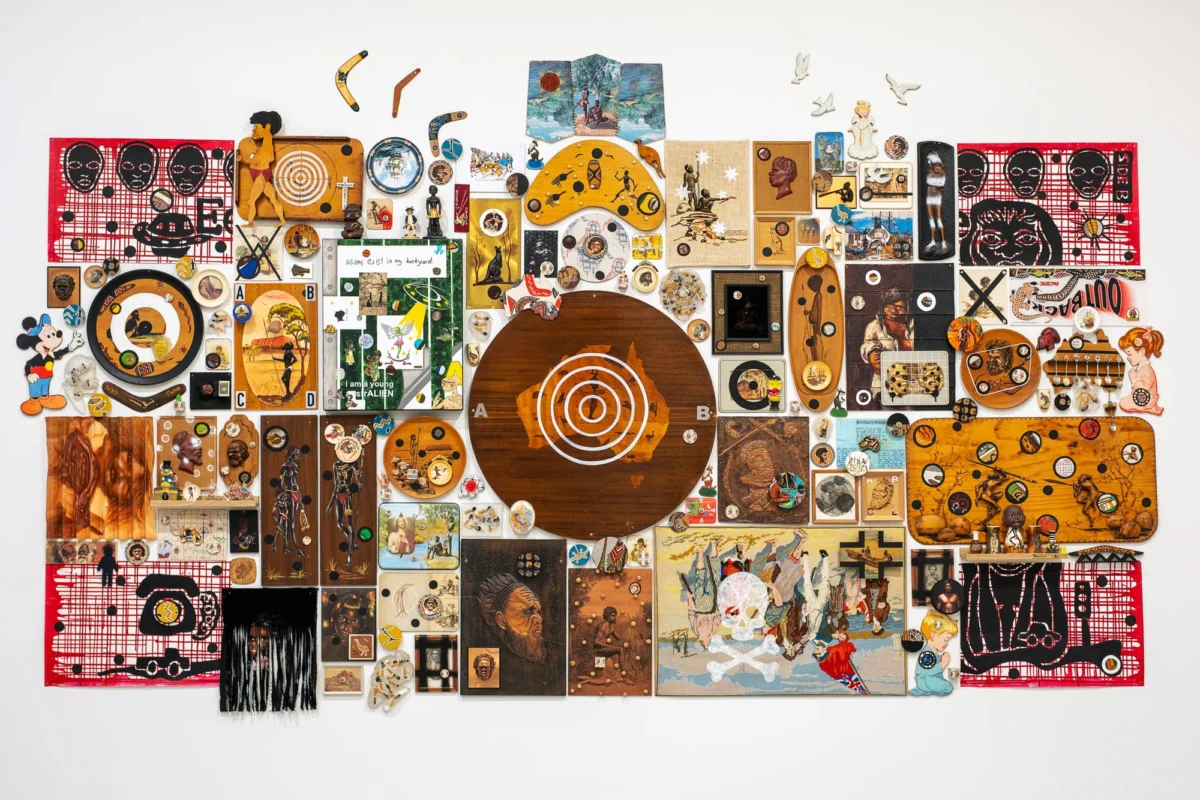
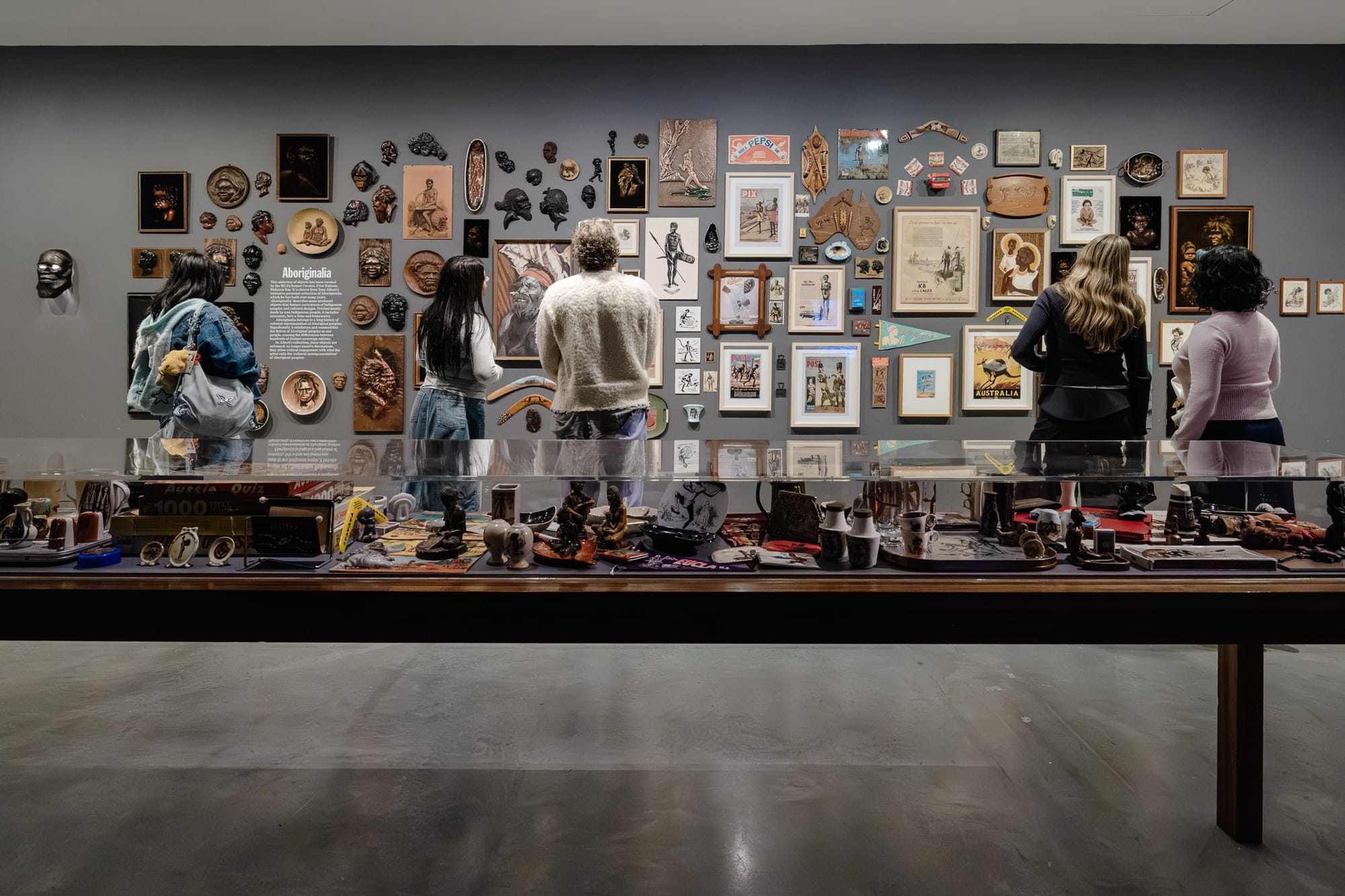
Central to Tony Albert’s artistic practice over the years has been what he and other scholars define as "Aboriginalia"—a vast category of manufactured objects produced largely by non-Indigenous creators for non-Indigenous audiences, explicitly designed to depict Aboriginal people, art, and culture through reductive, stereotypical lenses. For this comprehensive exhibition, more than 2,500 individual examples drawn directly from the artist’s sprawling personal collection were brought together. The dazzling, overwhelming display included everyday household and decorative items such as matchboxes, ashtrays, tea towels, novelty figurines, decorative plates, and velvet paintings.
In the opening gallery of the exhibition, a section thoughtfully curated by former MCA curator of First Nations art Rebecca Ray, these domestic objects were arranged into an overflowing yet meticulously calculated taxonomy. Displayed en masse, the sheer physical volume of the collection laid bare the staggering scale at which racist and stereotypical imagery has been industrially reproduced and complacently consumed throughout Australia’s modern history.
This immersive presentation demanded sustained, uncomfortable attention from museum visitors toward material that is far too commonly dismissed as harmless kitsch or nostalgic memorabilia. Albert and Johnson McLean have frequently described this immense accumulated archive as “anecdotal, not academic,” noting that it is firmly grounded in the artist’s intimate, sustained proximity to these objects rather than through traditional, sterile institutional classification. Bringing this populist collection directly into the pristine white cubes of the MCA exposed the longstanding institutional exclusions that silently underpin traditional museum categories of cultural value and aesthetic worth.
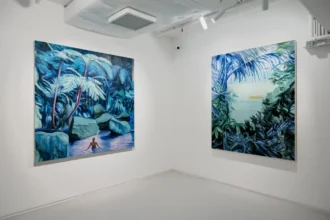
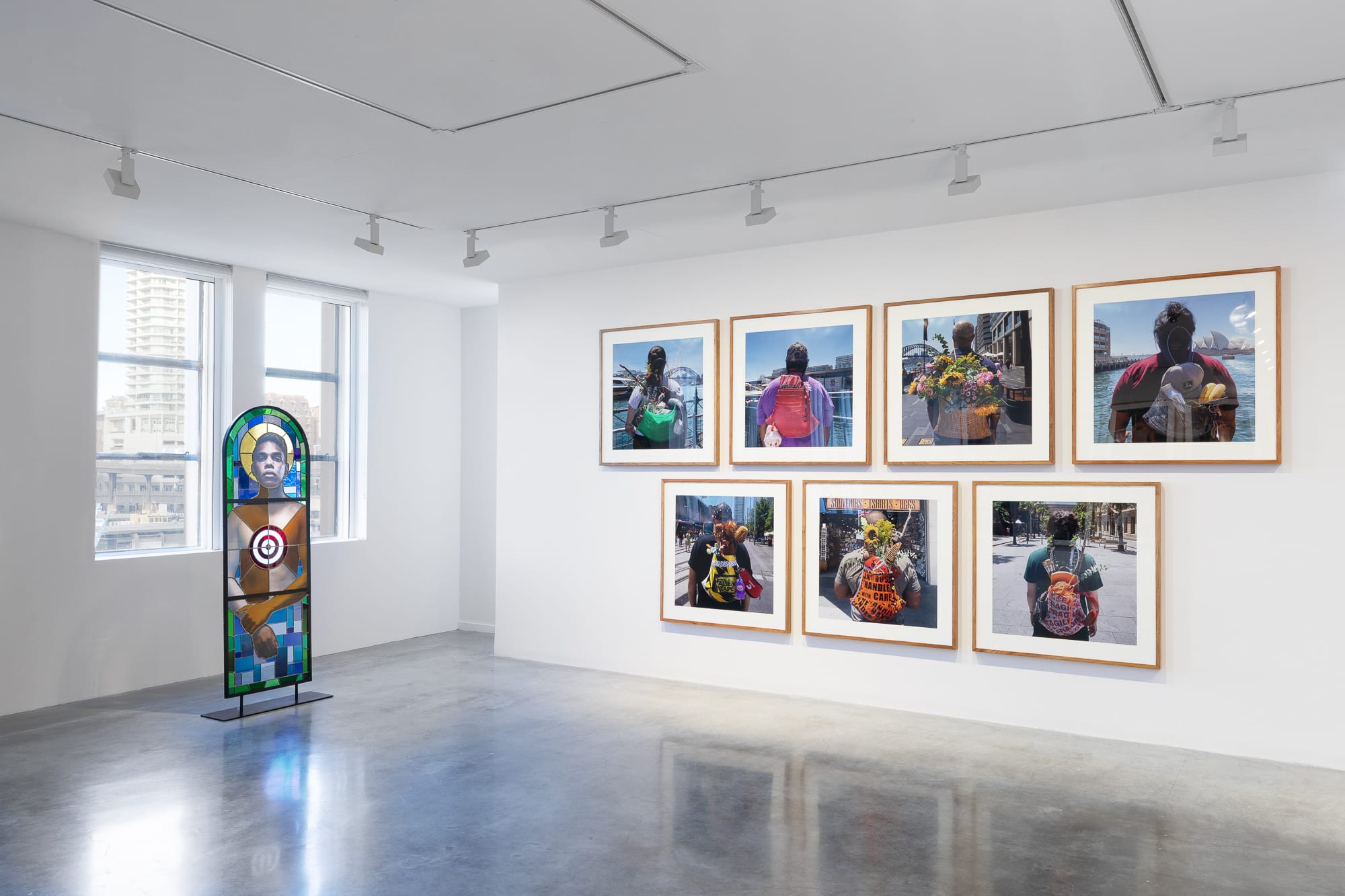
As visitors moved deeper into the exhibition space, the galleries shifted in tone and focus away from caricatured historical representations of Aboriginal bodies and toward empowered, complex contemporary Indigenous figures. Developed in close collaboration with Girramay artist Erica Muriata, Albert’s striking photographic series Optimism II (2026) depicts contemporary Indigenous individuals positioned around the iconic vistas of Sydney Harbour. In these works, the subjects are shown carrying jarwun—traditional, exquisitely woven baskets crafted by Muriata—which are filled with everyday, present-day ephemera such as modern headphones, native flora, bottled water, and mass-produced koala trinkets.
Photographed deliberately from behind, the figures gaze outward across the sparkling waters of the harbor. By framing the composition in this manner, Albert invites viewers to share the subjects’ own horizon rather than inspect them as passive anthropological subjects or exoticized spectacles. The artwork successfully reclaims the Sydney shoreline; within this modern frame, the Aboriginal body is definitively no longer treated as a temporary keepsake or a disposable tourist commodity.
This direct visual address also serves as a sophisticated response to the MCA’s specific institutional setting and its daily foot traffic, where international tourists make up a substantial portion of visiting crowds. The exhibition did not presume that every visitor would arrive with prior familiarity with Albert’s artistic practice or the peculiar domestic history of the Australian Aboriginalia trade. However, this commitment to accessibility never slipped into oversimplification or cultural pandering. As Johnson McLean acutely observed, the commercial mechanisms that drive the racial souvenir trade are hardly unique to the Australian continent; by utilizing local ephemera, Albert effectively exposes a broader, insidious global colonial logic that any international viewer can readily recognize and reflect upon.
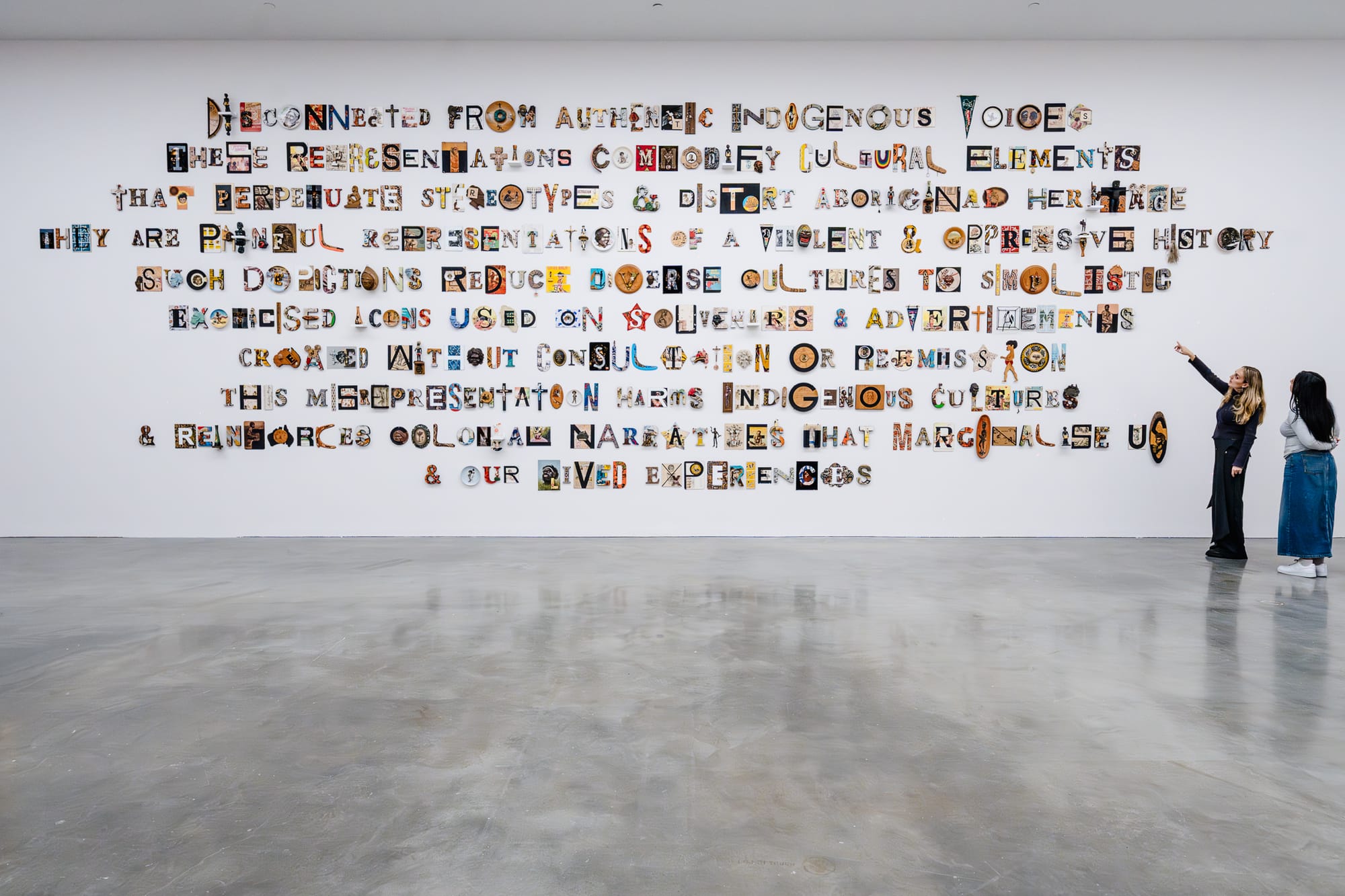
Throughout the retrospective, language remained one of the artist’s sharpest and most effective critical tools. The work Disconnected (2025) stands as a powerful wall-text manifesto composed of 450 individual letters cast meticulously from fragments of broken and discarded Aboriginalia. Rather than simply sweeping this cultural detritus away or hiding it from view, Albert physically splinters and reassembles the debris into an architectural counter-narrative. In doing so, he transforms the very physical material of objectification into an active, articulate apparatus of Indigenous critique.
This bold strategy of reinterpretation extends naturally into the revered institutional canon of Australian art history. Renowned 20th-century painter Margaret Preston sought to establish a distinct national modernist idiom in Australian art partly through the appropriation of Indigenous Aboriginal iconography—frequently doing so without acknowledging the original makers, traditional custodians, or cultural restrictions governing sacred designs.
Albert’s compelling work Conversations with Margaret Preston: Christmas Bells (2021), which draws directly from Preston’s 1925 woodcut print, is painstakingly pieced together from vintage fabric squares and commercial tea towels emblazoned with the generic, reductive label “Australian Aboriginal Art.” Positioned somewhere between a respectful homage and a sharp repudiation, the artwork forces the undeniable formal appeal of Preston’s modernist print to share physical and conceptual space with its deeply exploitative legacy. Albert deliberately suspends the viewer within this complex contradiction, allowing beauty and political violence, dry wit and rigorous critique, to coexist as unresolved, ongoing conditions of Australian culture and history.
Within Albert’s practice, conversation operates not merely as a thematic subject but as his primary working methodology. The exhibition itself emerged organically from a 25-year dialogue between the artist and curator Bruce Johnson McLean, alongside a longstanding professional ethos of working collaboratively with fellow artists, grassroots communities, and major cultural institutions. These enduring relationships allow Albert to continually challenge and expand the limits of what the modern museum collects, validates, and exhibits, while still operating effectively from within its institutional machinery. As Johnson McLean succinctly summarized, “the relationship is the project; the work is the product.”
The exhibition’s expansive public engagement initiative, titled the Aboriginalia Appeal, extended this relational framework outward by actively inviting museum visitors to donate objects from their own homes that they no longer felt comfortable owning or displaying. Albert views the acquisition and gathering of these unwanted objects as a restorative and even therapeutic process, as it successfully converts domestic kitsch back into tangible material evidence of how mainstream Australia has historically codified Indigenous people.
Ultimately, Tony Albert neither demands that the museum sanitize its history of displaying Aboriginalia nor asks the institutional archive to purge its past on cue. Instead, he makes each answer for the other. At Tallawoladah, where colonial history, national cultural authority, and tourist commerce remain uneasily entwined, the artist successfully transforms the souvenir from a stagnant, harmful trope into an active, living testimony within a contested national history.