In the 16th-century esoteric text Gyeongmong yogyeol ("The Secret to Banishing Ignorance"), the esteemed Korean scholar and philosopher Yi I set forth a foundational maxim for lifelong learning: "A learner must face toward the Way with sincere heart and not disturb his will with various worldly matters." Rooted deeply in a syncretic blend of Confucianism, Daoism, and Zen Buddhism, this aphorism underscores the rigorous intellectual discipline and quiet inner cultivation that have historically defined traditional literati art across East Asia.
Now, this centuries-old ethos finds a striking contemporary echo in "Where Grain Becomes Light," a solo exhibition by South Korean artist Kim Duck-Yong currently on view at Soluna Fine Art in Hong Kong. Running through November 28, 2026, the exhibition serves as a profound meditation on nature, philosophy, and interiority. By utilizing organic mixed media and traditional craftsmanship as a lens through which to examine the external world, Kim transforms physical gallery space into an environment dedicated to quiet self-examination and philosophical reflection.
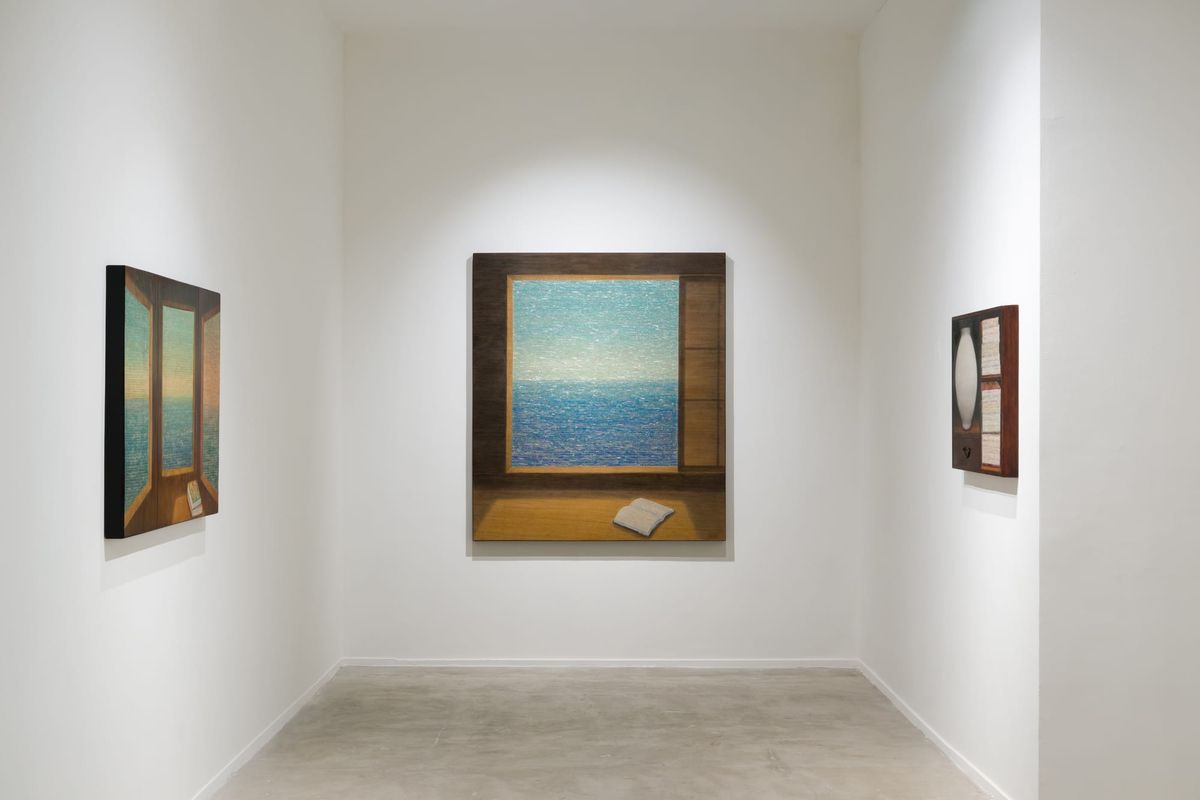
The exhibition’s curatorial journey begins on the ground floor of the gallery, which has been thoughtfully transformed into a salon of seaside portals. Chief among these works is Borrowed Scenery – Light and Grain (2026), a monumental piece that exemplifies the artist’s acute sensitivity to material and subject matter. Kim grew up immersed in East Asian philosophies that emphasize a harmonious relationship with the natural world, and in this work, that philosophical background becomes essential to the physical construction of the piece.
The depicted window frame of a rustic cabin is rendered using actual weathered wood, grounding the viewer in a tangible architectural reality. Beyond the frame, a coruscating, luminous ocean vista unfolds, constructed entirely from mother-of-pearl—a shimmering, iridescent substance found exclusively inside the shells of marine mollusks. In the immediate foreground, an open book rests quietly in a patch of warm sunlight, subtly alluding to Confucian ideals of lifelong learning, intellectual rigor, and erudition. Calm, focused, and remarkably restrained, the artwork is shaped by its profound simplicity. It cultivates an image that is, precisely as its title suggests, "borrowed" from the surrounding environment, deeply held ideologies, and lived human experience.
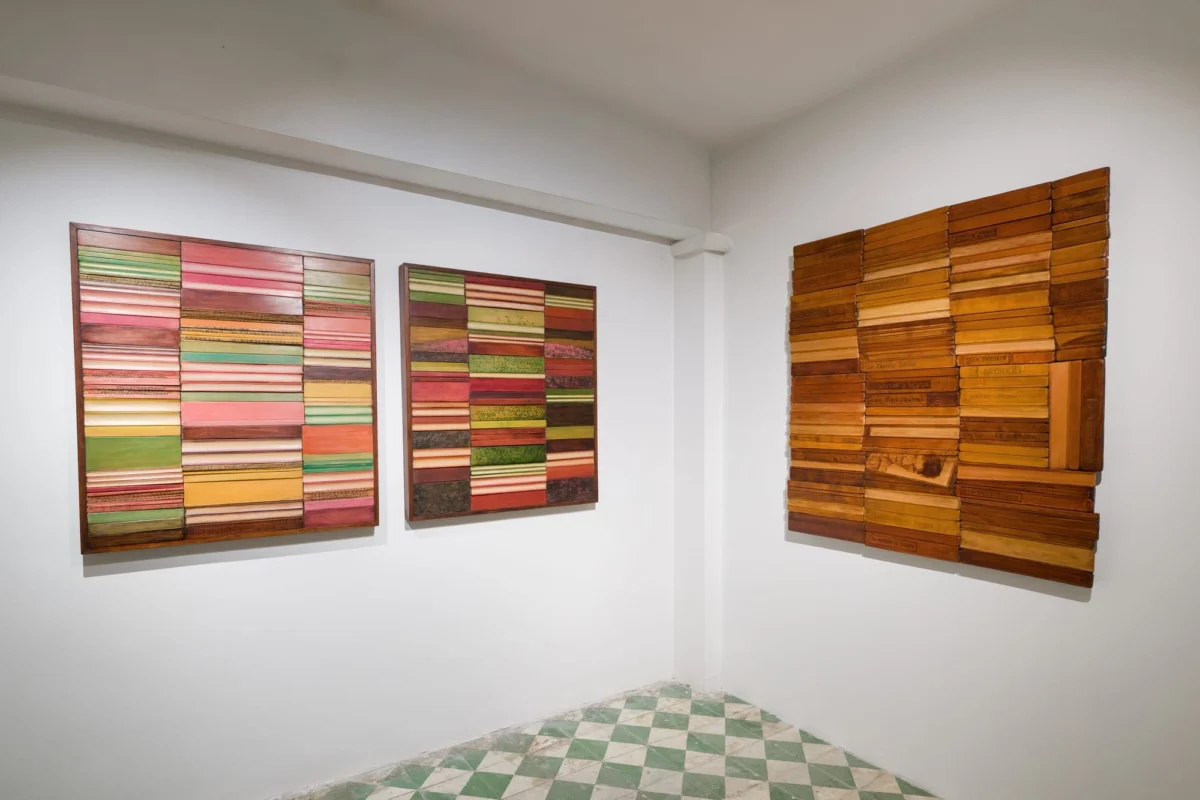
Ascending to the gallery’s upper level, these philosophical concepts manifest in a more understated yet equally powerful manner. Here, viewers encounter The Beauty of Accumulation series (2013– ), an ongoing body of work that showcases wooden blocks meticulously decorated using dancheong, the traditional Korean method of wood-dyeing and architectural coloring. In these intricate panels, the blocks are arranged to resemble vertical stacks of books. Warm autumnal colors define the covers and spines of the imaginary volumes, while the natural grain of the wood stands in ingeniously for pages.
On several of these stacked wooden panels, pithy philosophical quotes from Yi I are inscribed, gently urging aspiring sages-in-training to pursue their studies with diligence and a sincere heart. In another panel, the painted volumes bear titles drawn directly from the celebrated oeuvre of Vincent van Gogh. These layered references tie Kim’s contemporary practice not only to the classic literati ideal of being well-read and intellectually cultivated, but also to a much wider global pictorial tradition of observing and representing the natural world. The direct homage to van Gogh evokes the Dutch post-Impressionist painter’s intense, obsessive attention to color and light—a core preoccupation that Kim similarly pursues in the shimmering, optical refractions playing across his striated, mother-of-pearl seascapes.
Throughout the exhibition, Kim’s works exude a distinct and tranquil steadiness. Their physical materials engage directly with the organic world, while their underlying methods and cultural influences are distilled from a lifetime of artistic dedication and philosophical inquiry. Yet, despite the undeniable elegance of his ocean sunrises and the contemplative weight of his carved pillars of novels, neither the seascapes nor the books are ultimately the true subject of the art.
What remains on display is something far more intangible: Kim’s own ongoing process of inner cultivation. This quiet artistic pursuit powerfully recalls another enduring sentiment from Yi I: "Let this mind be like the bright sun in the blue sky, that people are able to see."
Harison Butler is an editorial intern at ArtAsiaPacific.