YONGIN — Running from September 1 through December 27, 2026, the latest edition of Art Spectrum at the Hoam Museum of Art offers a sprawling, multi-layered meditation on contemporary artistic practices across Asia and its intersecting global diasporas. Titled ARoomWhereEveryRadioIsTunedToDifferentStations—a compacted string of words purposefully stripped of gaps to withhold a declarative cadence—the biennial exhibition brings together 23 participating artists and collectives whose works are housed primarily within the museum itself as well as dispersed across its expansive grounds.
Moving away from the holistic exploration of the "screen" that defined its previous iteration, Art Spectrum 2026 adopts a distinctly polyphonic approach. Rather than forcing a singular, overarching intellectual narrative or attempting to decenter Western, human-centric, and extractivist paradigms through predictable biennale formulas, the exhibition poses a simpler, more resonant inquiry: How might creative practices forged in widely divergent cultural, linguistic, historical, technological, sensory, political, and social conditions be brought into meaningful conversation under the broad geographic category of "Asia"?
Curatorially, the project acknowledges that "Asia" and "contemporary art in Asia" are neither stable nor rigid categories. Instead, the exhibition conceptualizes the region as a frequency spectrum and the museum as a receptive space, allowing artists to maintain their distinct singularity while remaining open to hearing one another across cultural frequencies.
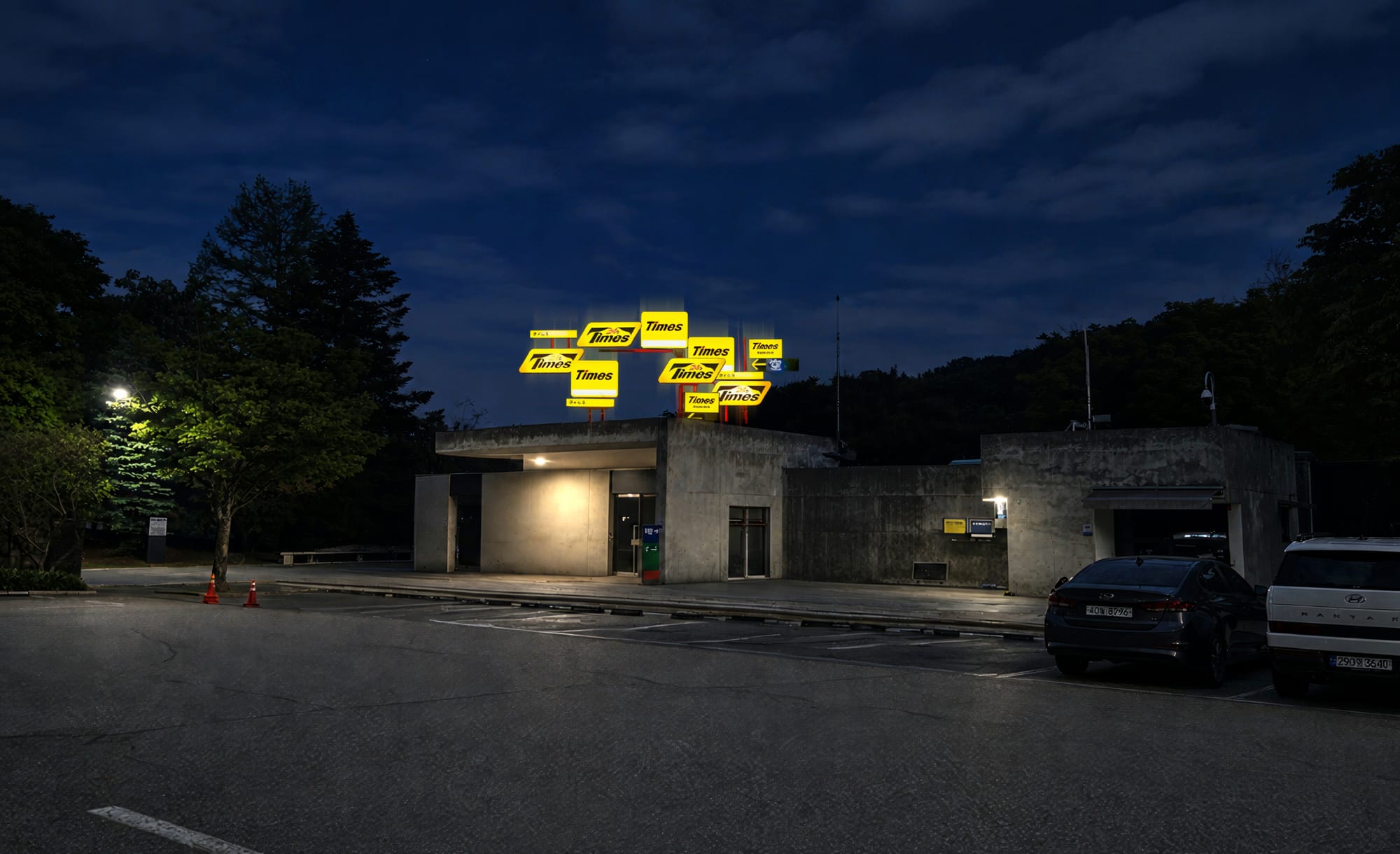
The thematic framework of the exhibition is introduced right at the threshold, in the museum’s parking lot. Arriving visitors are greeted by SIDE CORE’s time gate (2021), an assembly of the branded "Times" parking lot signs ubiquitous on Japanese streets. Rooted in the collective’s sustained attention to Tokyo’s transient urban fabric and the infrastructural disruptions surrounding the 2020 Olympics—where it was first staged on a vacant lot near the Olympic stadium—the work sets a tone of attentive observation toward the artificiality threaded through daily life.
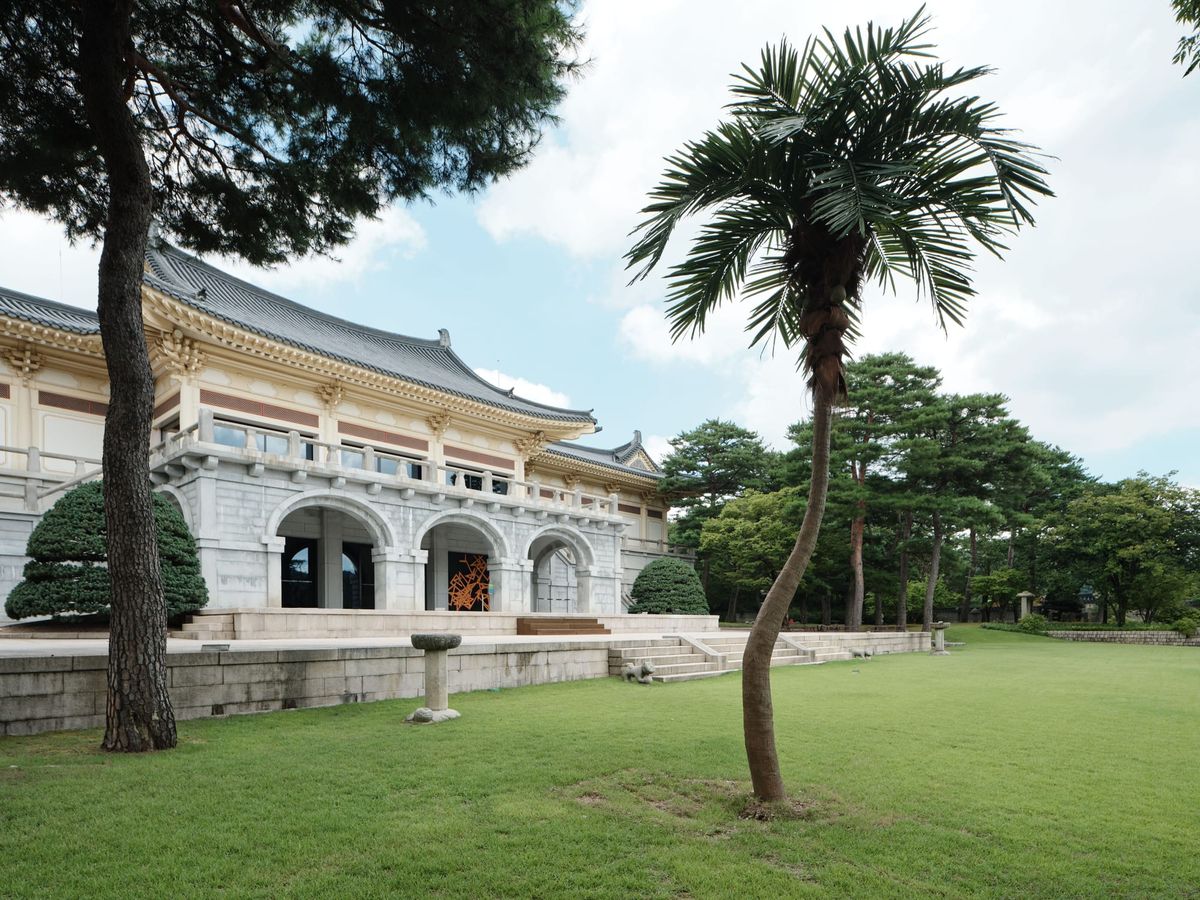
A short walk away on the museum’s lawns, Rachel Youn’s Parade Paradis II (2026) pits botanical life against manufactured spectacle with a light comic touch. The installation features an artificial palm tree whose crown rotates continuously, evoking both the showy foliage of amusement parks and the threadbare, extractive lexicon associated with tropicality and the exotic. Installed in the hushed gardens of the Hoam Museum of Art, Youn’s palm easily blends into the surrounding greenery. While the piece engages deeply with cliches, tourist fantasy, and diasporic belonging, it doubles as an accessible photo spot for families and couples driving past Seoul’s outskirts on weekends. As the exhibition catalog aptly describes the piece, it functions as "an antenna receiving signals of exoticism."
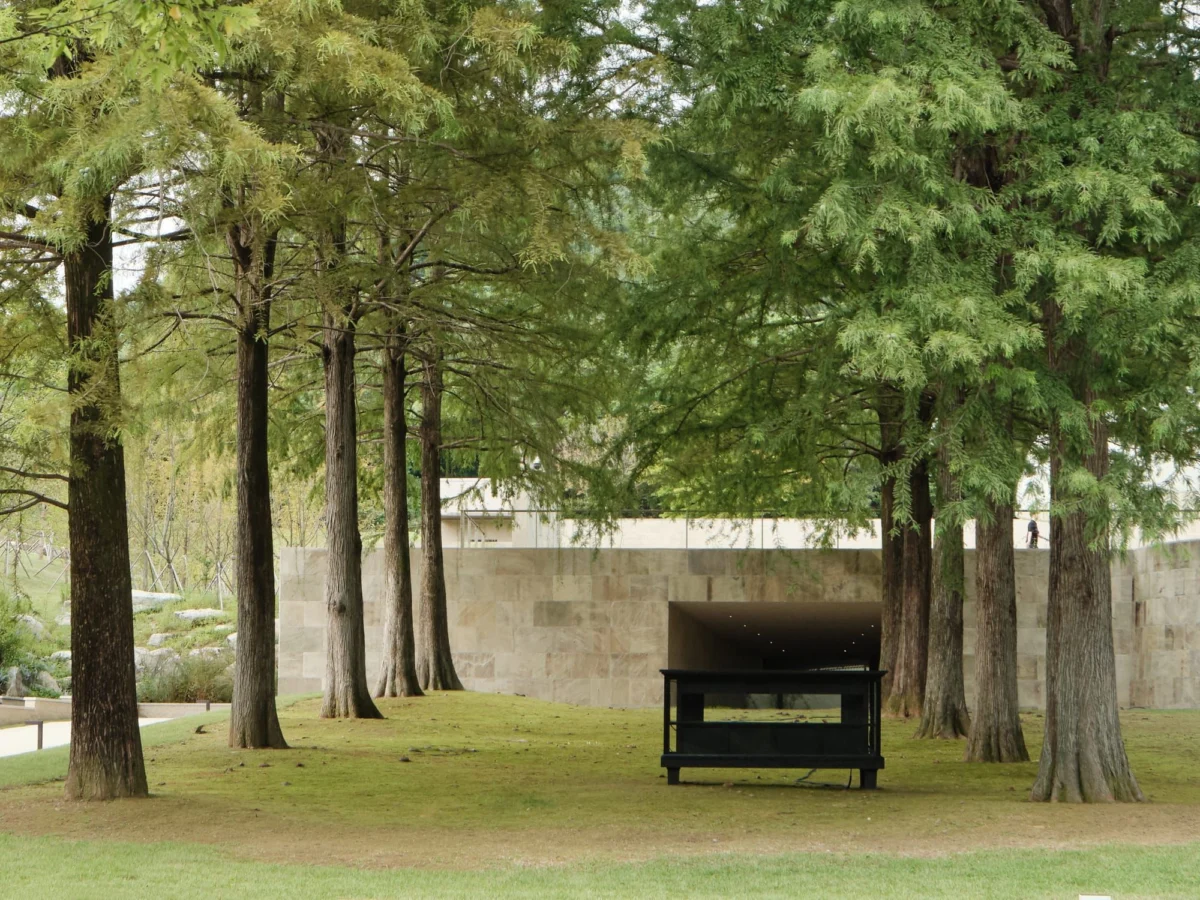
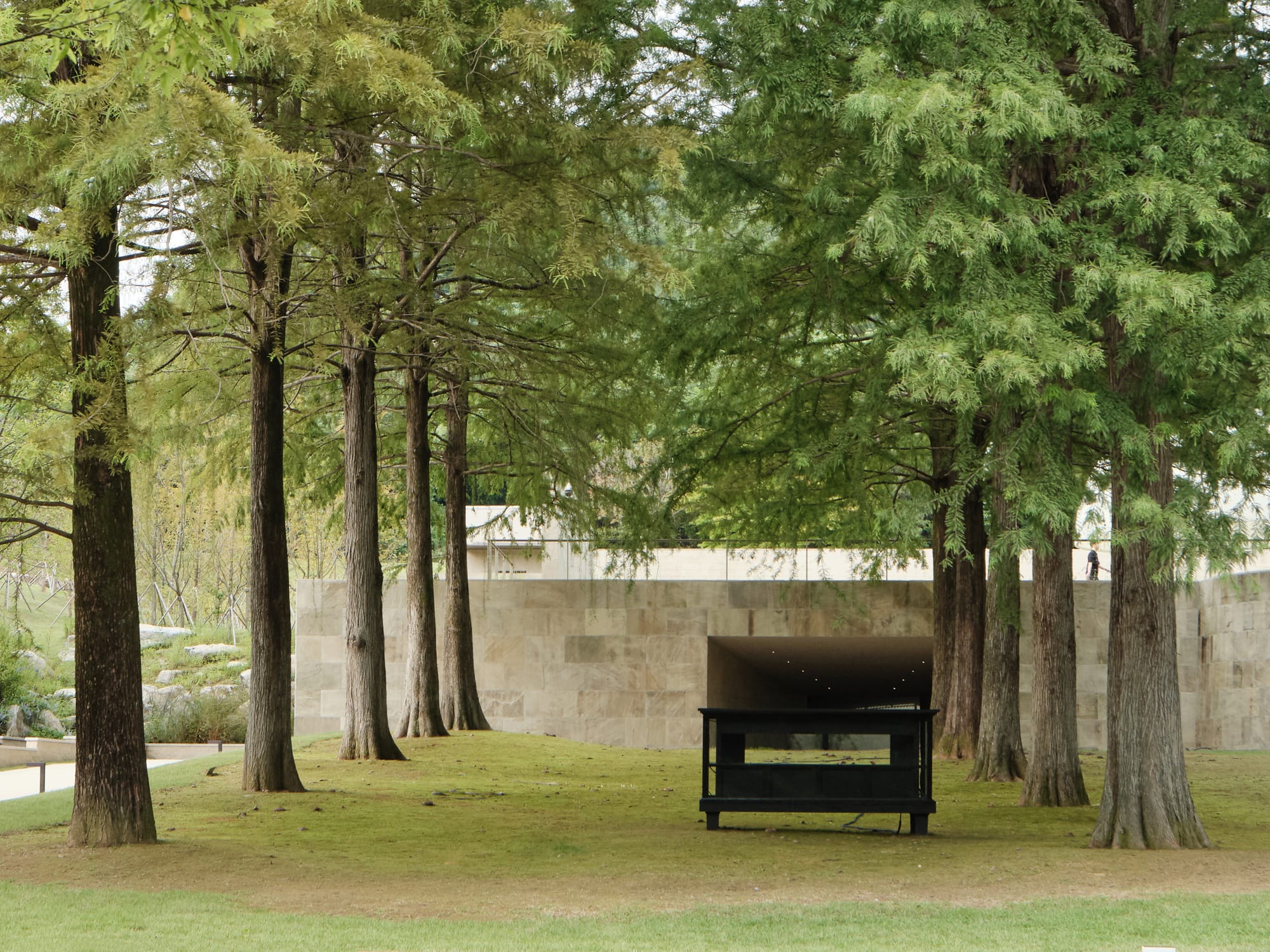
Nearby, Aerin Hong’s site-specific commission Music Siren (duet) (2026) similarly translates nonhuman life into unfamiliar artistic forms. Within a vitrine driven by a pair of motors, two lifelike toy butterflies beat their wings. Infrared sensors track their motion, registering reflected light as vibration, while a sequence of specialized devices ultimately converts these physical movements into a sequence of piano tones. Through this delicate mechanical sleight of hand, Hong separates the source of movement from the source of sound, ensuring that what the viewer sees and what they hear never quite align.
Upon stepping inside the museum galleries, visitors encounter SIDE CORE once again through rode work ver. under city (2023). This multichannel video documents a group of skateboarders navigating Tokyo’s subterranean infrastructure, traversing stormwater reservoirs, decommissioned tunnels, and maintenance corridors. Built largely on reclaimed land and perpetually vulnerable to natural disasters, Tokyo relies on these subterranean channels as a vital flood defense system. By stitching on-site footage together with 3D data, SIDE CORE links these isolated facilities into a single, unified virtual underground that mirrors the visible metropolis above.
The alertness to resource appropriation, ambient risk, and daily artifice demonstrated by SIDE CORE echoes—retroactively and without heavy-handed emphasis—the explorations of nature and fabrication pursued outdoors by Youn and Hong.
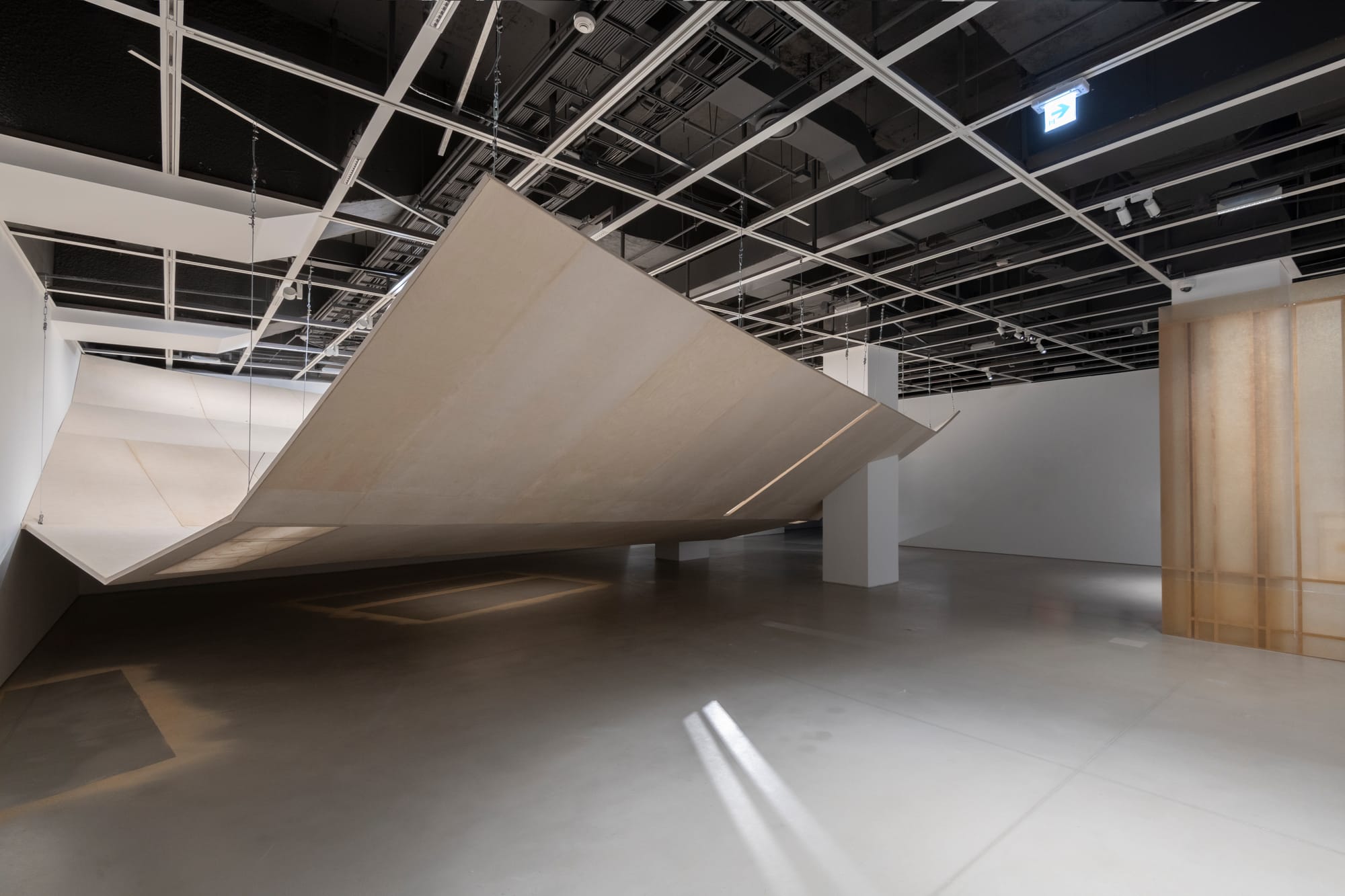
As visitors move deeper into the indoor galleries, hidden violence on both a personal and planetary scale emerges as a prominent frequency. In Suffocating (2026), artist Ruofan Chen employs wood, aluminum, sawdust, organza, polyester, and various threads of cotton, linen, and silk to construct a collapsed timber structure. Beneath the wreckage, fine sawdust is carefully arranged into two tidy rectangles. Inspired by the dense dust filling a woodshop she visited and the chronic, cumulative damage caused by fine particulates like glass fiber and resin, Chen renders the slow, invisible harm of physical labor perceptible through brute volume, weight, and accumulation.
A similarly immersive exploration of systemic exploitation unfolds in Elia Nurvista’s installation, which brings two distinct works into close dialogue. Plantation Cosmology (2026) features a tent made of traditional hand-drawn and hand-dyed batik textiles, adorned with scenes blending global trade, labor, ecology, and mythic creatures. Housed within this textile structure is the single-channel video Plantation Tragedy (2026), which depicts a surreal standoff among palm trees, plantation workers, a scientist, and a robot. In the video, each figure voices competing claims concerning progress, environmental justice, and workers’ rights, culminating in a plant revolt, a labor strike, and a tense threat from the robot to detonate the estate. Despite their different mediums and sensibilities, the practices of Chen and Nurvista converge powerfully on the hidden exploitation embedded in modern workplaces and the comorbidity binding human bodily health to planetary ecology.
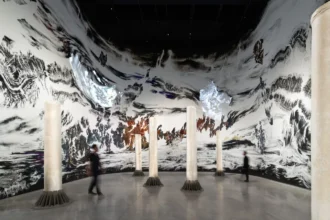
While the exhibition generally avoids asserting a rigid historical or political doctrine, several participating artists directly engage with specific historical traumas and nationalist mythologies. Musquiqui Chihying’s The Recasting (2025) utilizes three glowing, fog-filled glass vitrines and a three-channel soundscape to probe a deeply layered object history. The work centers on a bronze ding—an ancient Chinese cauldron—that was cast by the Japanese imperial army in 1937 using weapons seized in occupied Nanjing and subsequently engraved with cherry blossoms to commemorate a military victory. Shipped to Taiwan in 1951, the vessel was re-inscribed with Chinese characters denoting Bo’ai, or "universal love." In Chihying’s installation, the tripedal cauldron is represented by three empty, shattered vitrines where the disembodied spirits of the object, each carrying the memory of a different nation and its contested past, engage in an ongoing conversation.
In an adjacent dark room, Chulayarnnon Siriphol’s documentary-form video Red Eagle Sangmorakot: No More Hero In His Story (2024) traces how Muay Thai functions as a national sport carrying the weight of Thailand’s Cold War anxieties, class struggles, and state-sanctioned masculinities. The work examines how the sport continues to animate the interlocking systems of the monarchy, Buddhism, military authority, and virility that govern modern Thai society. Across both Chihying’s and Siriphol’s projects, human bodies and nonhuman cultural objects are laid bare as raw materials and vessels for state mythology.
Ultimately, Art Spectrum 2026 leaves visitors with a sobering reflection on a world perpetually composed of competing histories and discordant narratives. While the exhibition makes no attempt to resolve these tensions, it successfully makes its broader case: that contemporary art serves as an essential antenna, helping audiences scramble for signal and pattern in a world otherwise dominated by overwhelming noise.
Louis Lu is an associate editor at ArtAsiaPacific.