For travelers seeking an immersive wilderness experience marked by pristine landscapes, minimal trail congestion, and impressive summit success rates, the Lemosho route on Mount Kilimanjaro continues to stand out as a premier choice. Celebrated for its breathtaking scenery and diverse ecological zones, this trail offers mountaineers a front-row seat to some of East Africa’s most remarkable ecotourism features. As local operators highlight the advantages of well-paced itineraries, the spotlight is once again shining on how proper acclimatization can transform a challenging mountain expedition into an achievable dream.
The journey typically begins in the vibrant town of Moshi or Arusha, where climbers meet their support teams before embarking on a scenic drive to West Kilimanjaro via Sanya Juu. Travelers then arrive at the designated trailhead for official registration before commencing their ascent through the historic Londorosi Gate. While a seven-day trekking schedule remains a popular option for many visitors, experienced mountain guides and local destination management companies increasingly recommend the eight-day Lemosho route adventure trip. This extended itinerary provides superior acclimatization opportunities, which significantly boosts overall summit success rates for mountaineers of varying experience levels.
Beyond its high success metrics, the Lemosho trail is widely recommended for adventurers with a keen interest in sustainable travel and photographic safaris. The route weaves through untouched natural habitats, making it a favorite among conservation-minded trekkers who wish to minimize their environmental footprint while capturing the dramatic vistas of Africa’s highest peak. Alongside the Lemosho path, other itineraries such as the nine-day Northern Circuit and the Rongai route via the Mawenzi Saddle are frequently highlighted as excellent choices for those prioritizing ecotourism and wildlife photography. For travelers looking to combine their mountain climb with broader regional explorations—ranging from the sweeping plains of the Serengeti to the idyllic beaches of Zanzibar—local specialists like Kilimanjaro Tanzanite Safaris DMC offer comprehensive travel arrangements.
To understand the appeal of the journey, one must look at how the daily trekking plan unfolds across the mountain’s changing ecological belts. The adventure begins on the first day with a drive from Moshi or Arusha to the Londorosi Park Gate, a journey lasting approximately two hours. From this administrative checkpoint, a rugged forest track requiring a four-wheel-drive vehicle leads the expedition to the Lemosho Glades. Walkers then embark on a peaceful trek along winding forest trails, enveloped by lush greenery, before arriving at the Mti Mkubwa, or big tree, campsite, situated at an altitude of 2,750 meters after roughly three hours of walking.
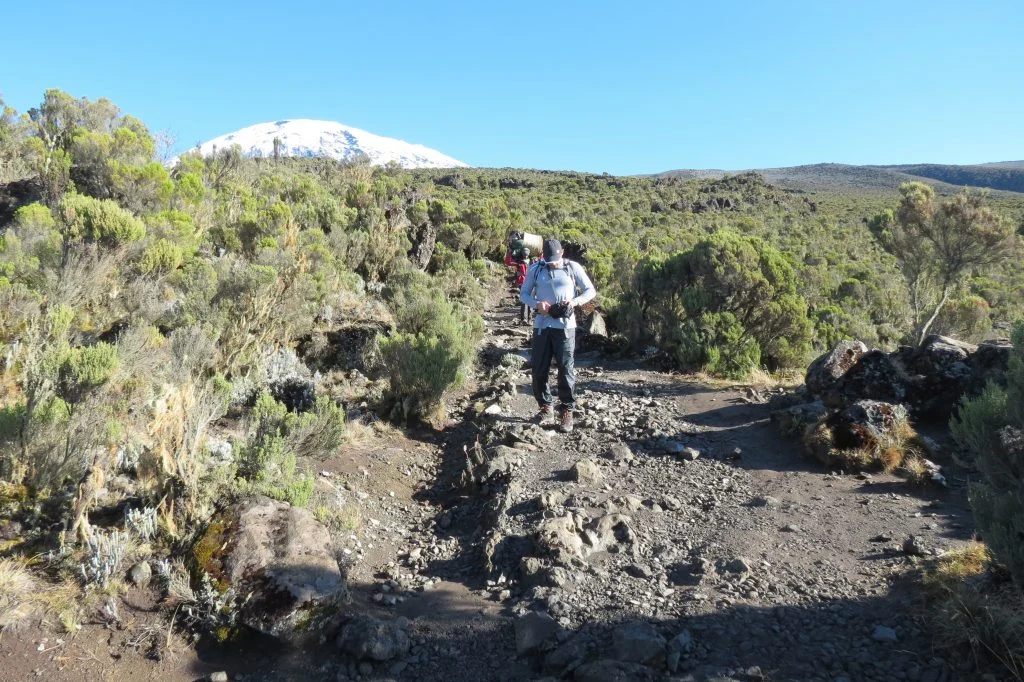
As the expedition progresses into the second day, the trail gradually steepens, guiding climbers out of the dense forest and into the giant heather moorland zone. Along the way, trekkers cross several bubbling streams before gaining the Shira Ridge at an elevation of approximately 3,600 meters. The path then descends gently toward the Shira One camp, nestled beside a stream on the expansive Shira Plateau at 3,500 meters. While this particular campsite can occasionally be omitted depending on the chosen pace, it serves as a wonderful introduction to the vast, open spaces characteristic of the western approaches.
The third day offers a gentle, restorative walk across the plateau, leading the team to Shira Two camp, which sits among moorland meadows near a running stream at 3,850 meters. Because a variety of walking paths are accessible across the plateau, this leg functions as an exceptional acclimatization day, allowing the body to adjust naturally to the rising altitude before pushing into more demanding terrain.
On the fourth day, the route directs climbers eastward toward the imposing mass of Kibo, passing key junctions before navigating toward the striking geological formation known as the Lava Tower. Shortly after navigating this landmark, the trail descends toward the sheltering embrace of the Barranco Hut, perched at 3,940 meters after about four hours of movement. Climbers opting for the comprehensive eight-day Lemosho itinerary enjoy an even more measured pace, continuing onward to sleep at Karanga Camp. This extra night at Karanga Camp provides invaluable additional time for physiological adaptation, proving exceptionally beneficial for those aiming to reach the summit with strength and clarity.
The fifth day introduces a thrilling challenge with a short scramble up the face of the Great Barranco Wall. This is followed by a steady traverse across scree and exposed ridges that lead directly into the Karanga Valley, resting at 4,000 meters beneath the towering icefalls of the Heim, Kersten, and Decken Glaciers. After climbing out of the valley, the path ascends a steep ridge toward Barafu Hut, a bleak, windswept base camp with sparse vegetation located at an altitude of 4,600 meters. Climbers spend the afternoon resting at Barafu Camp, eating early, and conserving their energy for the grueling push ahead.
The sixth day demands a very early start for the pivotal ascent to the rim of the Kibo Crater, threading a path between the Rebmann and Ratzel Glaciers. This steep climb typically takes around four hours, with the final stretch frequently blanketed in snow, making an ice axe or ski pole a useful tool for maintaining balance. From the crater rim, a final hour of steady walking leads triumphant climbers to Uhuru Peak, the highest point in Africa. On clear days, the summit rewards adventurers with sweeping, unforgettable views of Mount Meru to the west and the jagged, dramatic silhouette of Mawenzi to the east.
Following the emotional milestone of reaching the summit, climbers descend back to Barafu Hut for a well-deserved rest and lunch before continuing their descent to set up camp at Mweka Hut, located within the giant heather zone near the forest edge. For those possessing extraordinary stamina upon reaching the summit, optional excursions include descending to the Reutsh Crater to inspect the dramatic ice pinnacles of the Eastern Icefields.
The final seventh day involves a pleasant three-to-four-hour descent through beautiful, dense forest landscapes that ultimately bring travelers back down to the park gate, where waiting transport takes them back to civilization.
Pricing structures for these expeditions typically vary depending on the specific purpose of the trip and the size of the traveling party. Educational programs, ecotourism associations, travel agents, destination management companies, and student groups frequently qualify for discounted tour offers. Naturally, the cost for the eight-day Lemosho route package runs slightly higher than its seven-day counterpart due to the additional day of park fees, camping logistics, and operational support.
Standard inclusive pricing for these packages generally covers a comprehensive array of essential services. These typically encompass airport transfers to and from Kilimanjaro International Airport, all mandatory national park fees, fair wages for the dedicated team of guides, porters, and cooks, all meals consumed on the mountain, and a supply of clean, safe drinking water. Furthermore, packages include essential camping and accommodation equipment, applicable government taxes, official climbing completion certificates, comprehensive first-aid kits, and emergency medical evacuation coverage through AMREF Flying Doctor Air Rescue Insurance, alongside range rescue provisions and ground transfers to and from Arusha or Moshi.
To ensure climber safety and well-being, reputable local operators provide vital support equipment, including emergency oxygen bottles and pulse oximeters to monitor blood-oxygen levels throughout the ascent. Conversely, standard exclusions generally involve international flights to Tanzania, hotel accommodations in Moshi prior to the climb, entry visas, personal climbing gear—which remains available for local rental—and gratuities for guides, porters, and coordinators, as well as items of a personal nature.
Local operators often leave arrival night hotel accommodations in Moshi unbundled from the core package price, giving visitors the flexibility to select lodging that best suits their individual preferences and budgets. Industry specialists frequently recommend local eco-resorts and sustainable lodges in Moshi, noting that they offer excellent value, comfortable amenities, and a strong alignment with regional conservation values.
Travelers interested in planning an expedition or securing customized itineraries can reach out directly via electronic mail to local operations. Kilimanjaro Tanzanite Safaris Ltd operates as an established local tour operator rooted in Tanzania, boasting a strong reputation and positive reviews from past visitors across prominent travel marketplaces and consumer review platforms like TripAdvisor. As a comprehensive destination management company, the organization coordinates a wide array of regional adventures, ranging from wildlife safaris across Tanzania and mountain climbing expeditions to budget-friendly adventures, ecotourism excursions, walking safaris, nature treks, Mount Meru climbs, horseback riding, camel safaris, Zanzibar excursions, scuba diving, outdoor camping, hot air balloon safaris, photographic tours, beach holidays, and specialized honeymoon packages.