Singapore’s vibrant hospitality and tourism sector has achieved a significant milestone with the official launch of its very first joint Institute of Technical Education (ITE) and polytechnic Hospitality and Tourism Student Chapter. Unveiled on October 23, 2026, at the iconic Marina Bay Sands, the landmark initiative marks a decisive step forward in aligning academic training with the evolving demands of the nation’s service and tourism economy.
The launch took place during the second edition of the Singapore Hospitality and Tourism Conference (SHTC), a premier industry gathering that brought together approximately 480 students, educators, and key industry partners. The event served as a collaborative platform designed to strengthen the vital links between classroom education and real-world industry requirements, ensuring that the next generation of professionals is thoroughly equipped to navigate a dynamic global landscape.
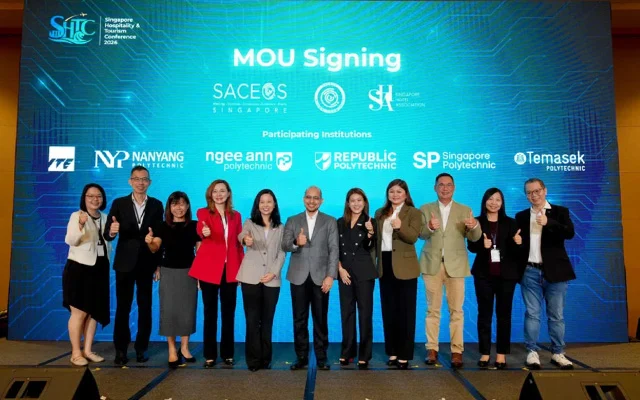
The establishment of the student chapter was formally sealed through a comprehensive memorandum of understanding (MoU) signed by six participating institutes of higher learning. These institutions comprise the Institute of Technical Education, Nanyang Polytechnic, Ngee Ann Polytechnic, Republic Polytechnic, Singapore Polytechnic, and Temasek Polytechnic. They were joined by major industry associations, namely the Singapore Association of Convention & Exhibition Organisers & Suppliers (SACEOS) and the Singapore Hotel Association (SHA).
Operating under the robust framework of the Tourism, Hospitality & Operations Management Sector Coordination Team—which is co-chaired by Temasek Polytechnic and Republic Polytechnic—the newly formed student chapter aims to seamlessly bridge the gap between academic preparation and industry needs. By fostering closer cooperation among educational institutions and trade associations, the initiative seeks to create a cohesive ecosystem that nurtures talent from the moment they enter their studies to the time they transition into the workforce.
Ong Huey Hong, assistant chief executive of the industry development group at the Singapore Tourism Board (STB), highlighted the crucial role the student chapter will play in supporting students as they embark on their professional journeys. She noted that the platform is engineered to help students smoothly transition into full-time careers in tourism through structured networking events, immersive learning journeys, and invaluable mentorship from esteemed industry partners such as SACEOS and SHA.
Elaborating on the practical value of the initiative, Ong pointed out that the primary hurdle for many learners lies in translating theoretical knowledge into practical execution. The challenge today is about learning and applying skills in real life, she observed, expressing her belief that the newly launched chapter effectively closes that gap by encouraging a greater number of industry players to actively engage students for internships and experiential learning opportunities.
Providing broader context on the health and trajectory of Singapore’s tourism sector, Ong shared encouraging statistics regarding workforce growth and student interest. Between 2023 and 2025, Singapore’s tourism workforce expanded by eight percent, climbing from 69,000 to 75,000 professionals. Concurrently, first-choice applications for tourism-related courses across polytechnics registered a robust 20 percent increase between 2022 and 2026, signaling sustained enthusiasm among young Singaporeans for careers in the sector.
While these figures demonstrate strong initial interest, Ong emphasized that the ultimate objective is to ensure that students not only pursue tourism education but also commit to building long-term careers within the industry. That is the fundamental reason why stakeholders are deeply invested in strengthening the connections between educators, industry leaders, and collaborative platforms like the SHTC, she added.
In tandem with the historic MoU signing, SHTC 2026 hosted a bustling career fair designed to directly connect eager students with more than 20 prominent employers. The recruitment showcase featured several first-time exhibitors, including renowned names such as Banyan Tree, the Museum of Ice Cream Singapore, and The Lo & Behold Group. Together, the participating organizations offered approximately 1,400 job and internship opportunities, giving students a direct pathway into prospective employment.
The career fair attracted a diverse mix of prominent tourism and hospitality enterprises, ranging from industry giants like Singapore Airlines and Capella Hotel Group to dynamic local events and tourism firms such as Woopa Group, UPGroup Asia, and event agency The MasterPlan. The strong turnout of both multinational brands and local enterprises underscored the broad spectrum of career paths available within Singapore’s vibrant ecosystem.
Jasmine Ho, founder and managing partner of event agency The MasterPlan, underscored the mutual benefits of the career fair, particularly for smaller enterprises. She noted that participation provides exceptional exposure for students to fully understand the diverse composition of the industry, especially from an agency perspective. Pointing out that smaller firms lack the household name recognition enjoyed by industry heavyweights like Marina Bay Sands or Informa, Ho described SHTC as a valuable platform for small and medium-sized enterprises (SMEs) to gain visibility while simultaneously showcasing the wider range of opportunities accessible within the broader tourism landscape.
Complementing the networking and recruitment efforts, SHTC 2026 also featured a student hackathon generously sponsored by Marina Bay Sands. The competition challenged 40 participating students to explore innovative ways of integrating artificial intelligence with human-centred hospitality. This engaging exercise directly reflected the overarching theme of the conference, which placed a strong emphasis on leveraging technology as a supportive tool to enhance, rather than replace, the essential human element in hospitality.
Reinforcing this philosophy, Ong remarked that hospitality remains fundamentally a people business at its core, describing it as still very human-centric. While acknowledging that artificial intelligence can successfully automate certain routine processes and operational workflows, she maintained that genuine empathy, emotional intelligence, and the ability to consistently deliver an exceptional guest experience remain completely irreplaceable.
Looking ahead to further industry empowerment, the STB announced the upcoming launch of the Age for Productivity grant, scheduled to take effect on November 1, 2026. The initiative will introduce pre-approved digital concierge and robotics solutions designed to assist tourism companies in seamlessly adopting cutting-edge technology, thereby driving operational efficiency while preserving the warmth and quality of human-delivered service across Singapore’s hospitality landscape.