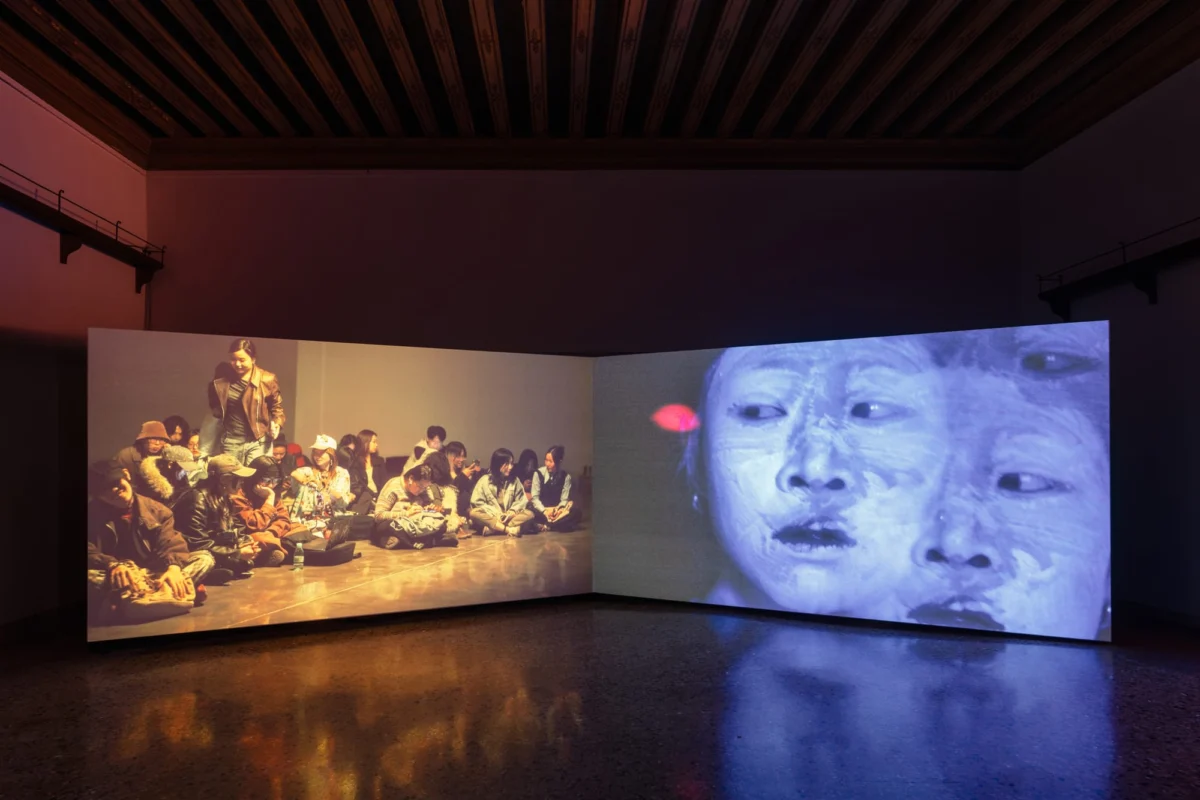
Beijing-based artist and Sigg Prize 2023 winner Wang Tuo approaches the complex fractures of Chinese modernity with the meticulous patience of an archivist combined with the deeply immersive instincts of a master storyteller. Working primarily in the medium of moving images, Wang constructs dense, psychological allegories that draw heavily from personal memory, historical trauma, and collective consciousness. His evolving body of work transforms cinema into an archaeological site where past ideologies, suppressed folklore, and contemporary realities continually collide.
Wang’s artistic journey is defined by a rigorous exploration of how historical narratives are constructed, manipulated, and ultimately forgotten. In his earlier work, Meditation on Disappointing Reading (2016), the artist explores themes of exile and dislocation through a narrative where a daughter attempts to summon the spirit of her departed mother by meticulously recreating the traditional dishes of her lost childhood in Shanghai. This intimate focus on domestic ritual and emotional absence laid the groundwork for his subsequent investigations into systemic power structures.
The mechanics of state scrutiny and institutional power came to the forefront in The Interrogation (2017) and its later, more vertiginous counterpart, The Second Interrogation (2023). In these works, Wang turns the bureaucratic mechanics of vetting inward, examining the psychic grip of institutional authority and its far-reaching influence on the contemporary Chinese art world. By blending suspense with historical critique, these films question how individuals navigate ideological boundaries and how institutional memory is officially sanctioned or erased.
Perhaps his most ambitious and critically acclaimed achievement to date is The Northeast Tetralogy (2018–2021). In this expansive four-part project, Wang braids local folklore, traditional ghost stories, and historical narratives into a singular, hallucinatory cinematic experience. To articulate this complex blending of different dimensions and timelines, Wang developed a conceptual framework he refers to as “pan-shamanization”—a fluid channel that allows communication between disparate temporalities, historical traumas, and spiritual dimensions. Layered, incantatory, and visually arresting, his cinema insists that art must mirror the inherent tangles and contradictions of the world it seeks to reflect.
Wang’s international profile continues to expand significantly through a series of major presentations and global exhibitions. Earlier this year, the artist debuted The Experimental Paradigm of Ownership and Autonomy (2026), a striking two-channel video installation, as part of the group exhibition “Canicula” hosted by the Fondazione In Between Art Film at the historic Complesso dell’Ospedaletto in Venice. Shortly after, he unveiled another major new work, Ratchet Drill (2026), at the 16th Gwangju Biennale. Both of these contemporary installations represent crucial chapters within his ongoing, expansive quadrilogy.
Building on this momentum, Wang is preparing for a major solo exhibition scheduled to open at Hong Kong’s Tai Kwun in February 2027. This upcoming institutional exhibition will offer audiences a comprehensive look at his latest cinematic explorations and thematic preoccupations. In the forthcoming March and April 2027 issue of ArtAsiaPacific, the publication turns its focus toward Wang’s multidisciplinary practice, offering a deep-dive meditation on absence, collective memory, and the recurring historical cycles of control and amnesia that continue to haunt modern society.
Louis Lu is an associate editor at ArtAsiaPacific.