Beyond the Ring Road: Navigating the Raw Wilderness and Rising Realities of Iceland’s Volcanic Highlands
Accessible only to those prepared for unpredictable elements, Iceland’s highland routes promise adventure beyond the reach of most. Weathered gravel paths cross vast, raw landscapes seldom altered by human presence. Making the journey here reshapes what it means to explore wild places responsibly and safely.
The stark differences between Iceland’s interior highlands and its more-traveled coastal routes are immediately apparent upon arrival. While the well-maintained ring roads skirt the island’s periphery, linking coastal towns and populated areas with relative ease, highland roads slice directly through its volcanic heart, offering a sense of isolation rarely experienced elsewhere in modern travel. For many explorers, driving Iceland’s rugged F-roads transforms an ordinary road trip into a genuine wilderness experience, opening up vast possibilities for backcountry discovery that remain entirely hidden from the standard tourist path.
The practical difference centers fundamentally on remoteness, severely limited infrastructure, and the uniquely rugged terrain that demands both deep preparation and profound respect from every traveler venturing off the main circuit. Where the coast offers convenience, fuel stations, and steady cellular connectivity, the interior presents an environment governed almost entirely by nature. As tourism continues to grow across the North Atlantic island nation, balancing the allure of these untamed interior routes with safety, self-sufficiency, and rigorous environmental stewardship has emerged as a central challenge for modern adventurers seeking to experience the raw interior without leaving a lasting scar on the landscape.
Unpredictable terrain and constant environmental changes
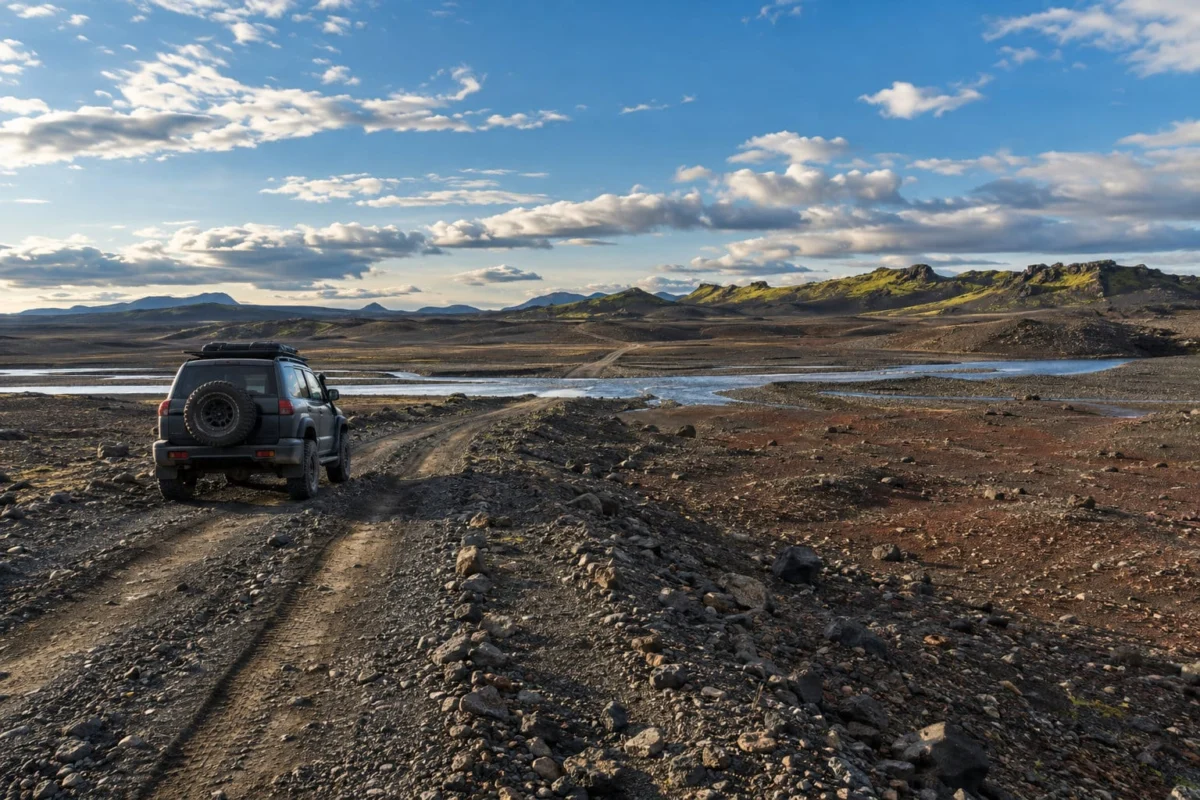
Unlike the paved, predictable highways that trace the Icelandic coast, highland roads are typically rutted gravel tracks that wind relentlessly across jagged lava fields, expansive volcanic deserts, and wide glacial rivers. These routes frequently challenge motorists with formidable obstacles, most notably unbridged river crossings whose depth, temperature, and current can shift dramatically and with alarming speed in response to heavy rainfall or rapid seasonal snowmelt.
Travel speeds in this interior environment are necessarily much slower, as loose volcanic gravel, ash, and frequent washboard surfaces significantly reduce tire traction and demand exceptionally careful, continuous navigation. Potholes, sharp and blind turns, and sudden uneven sections keep drivers constantly alert, emphasizing the absolute necessity of high-clearance vehicles and an adaptive, cautious mindset. Because meteorological conditions in the highlands can shift with little to no warning—bringing sudden squalls, zero-visibility fog, or unexpected temperature drops—drivers must constantly reevaluate their surroundings and be prepared for sudden environmental changes that can alter a route in a matter of minutes.
Planning, safety, and remote self-sufficiency matters
Before setting out into the interior, meticulous route planning and the building of conservative, flexible timelines are essential to avoid dangerous time pressure when confronting unpredictable conditions. Because the weather and river levels can change overnight, turning a manageable track into an impassable barrier, designated turnaround points should always form a core part of any travel plan. Flexibility and extreme caution serve as the true backbone of safe travel in a region where rigid itineraries can quickly lead to perilous situations.
Communication gaps are the absolute norm rather than the exception on these remote tracks, and professional support or emergency services are rare or entirely non-existent for miles in any direction. It is wise to prepare for potential vehicle recovery or mechanical delays without ever counting on outside assistance. Carrying essential emergency tools, proper navigation equipment, and keeping others reliably informed of a detailed daily itinerary can help mitigate severe risk and allow a crucial measure of self-sufficiency when travelers find themselves far from help.
Environmental stewardship while exploring remote landscapes
Staying strictly on marked tracks is paramount to protecting fragile volcanic soils and delicate arctic mosses from irreversible damage, making any form of off-road driving not only ecologically harmful but strictly prohibited under Icelandic law. Minimizing wildlife disturbance and respecting seasonal road closures—which are put in place precisely when the ground is too wet and vulnerable to withstand vehicle weight—are key components of responsible travel, preserving the integrity of the highlands for future generations.
Leave No Trace principles take on an added, critical importance in the wide-open, starkly beautiful terrain of Iceland’s highlands, where a single piece of litter or a patch of tire-inflicted soil damage can remain vividly visible for years. Practically, this means planning ahead to pack out all rubbish without exception, avoiding the construction of new fire rings or rock cairns that scar the horizon, and treading exceptionally lightly even during short stops to stretch or take in the sweeping, panoramic views.